Injectidry Water Damage Restoration in Fontana: A Homeowner’s Guide
Injectidry restoration in Fontana costs roughly $1,200 to $4,500 depending on floor area and how many cavities need treatment, but the real cost question is what you avoid: demolition. A contractor told a Fontana homeowner her entire hardwood floor had to be demoed after a dishwasher leak. A second opinion with an Injectidry mat system saved the floor and $4,200 in replacement costs. If you’d rather not navigate this alone, call Dry Line Water Damage in Fontana at (833) 589-5317.
What an Injectidry System Actually Does
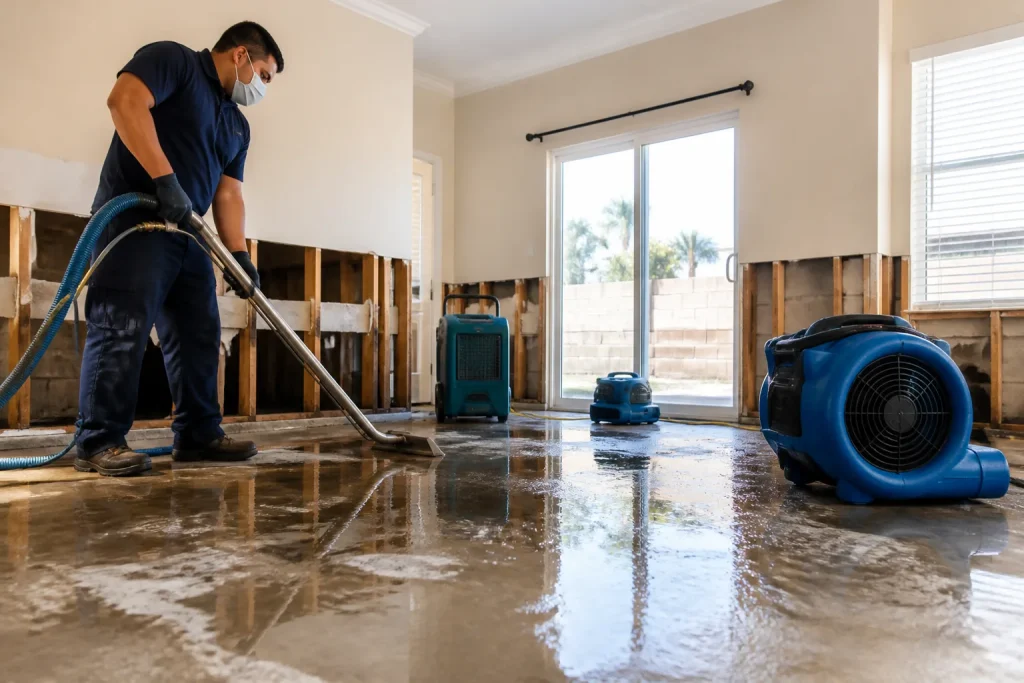
Most homeowners think drying means running fans until things feel dry to the touch. That works for surface moisture. It does nothing for water trapped under hardwood, inside wall cavities, or beneath cabinets. Injectidry solves that problem with negative air pressure. Here’s how it works: a mat or panel seals over the affected surface and connects to a vacuum hose. The system pulls conditioned, dehumidified air through the structural assembly, forcing moisture out of places a fan can’t reach. Water gets extracted, captured, and removed from the space.
We run these systems alongside Dri-Eaz and Phoenix dehumidifiers on Fontana jobs where cabinet subsidence or slab-on-grade construction traps water. The Injectidry panel sits flush against the floor or wall and stays there for 24 to 72 hours, pulling moisture continuously. At the end of the run, we document moisture content readings that confirm what actually dried. That documentation is the difference between “feels dry” and the documented dry standard your insurer will accept.
What Separates Injectidry from Fans and Dehumidifiers Alone
- Air movers dry exposed surfaces only. Injectidry draws air through hardwood, subfloor, drywall, and cabinet bases.
- Injectidry targets specific cavities and layers, not just the room’s general humidity.
- It prevents the warping and cupping that follow surface-only drying attempts on hardwood.
- It produces a documented moisture removal curve, which matters when the adjuster asks for proof.
In Fontana, where summer temperatures above 100 degrees already stress hardwood and composite materials, a slow-drying wall cavity becomes a mold invitation within 48 hours. Injectidry shortens that window dramatically.
When Injectidry Is the Right Tool in Fontana Homes
Not every water event justifies panel drying. But Fontana’s housing stock includes a lot of slab-on-grade construction, where hardwood has been installed directly over concrete. That’s a perfect case for Injectidry. Water from a supply line leak, dishwasher discharge, or washing machine overflow gets wicked under the flooring. The concrete holds it there. Demolition crews love this scenario because it bills as full floor replacement. The reality is that Injectidry mats can often dry the floor in place.
Other Fontana scenarios where we deploy Injectidry:
- Water in wall cavities after a second-floor leak or roof penetration. Panels draw air through the drywall and framing, drying the cavity without cutting inspection holes in every stud bay.
- Under-cabinet moisture from appliance supply line failures. Without Injectidry, the standard move is pulling cabinets off the wall. With panel drying, the cabinet base and subfloor get treated in place.
- Hardwood over concrete in Fontana homes built after 1990, which is the common slab-flooring combination.
- Multi-layer floors where tile, marble, or vinyl sits on top of wood subfloor trapping water between layers.
We pulled a panel system out of a kitchen over in the Southridge neighborhood last month. The homeowner’s refrigerator icemaker line had been leaking behind the cabinet for weeks. A restoration franchise quoted full cabinet removal and flooring replacement. We ended up drying the cabinet bases and the subfloor through negative pressure. The only thing that came out was the toe kick. The homeowner kept her kitchen, and the insurance claim dropped by nearly half. Dry Line Water Damage runs these jobs regularly.
Reading the Drying Data: What the Numbers Mean
A legitimate Injectidry setup is not complete without moisture mapping. Before panels go down, a technician takes baseline moisture content readings across the affected area using a penetrating or non-penetrating moisture meter. The key numbers to understand: wood with moisture content above 16% is wet enough to support mold growth. The dry standard, the target restoration contractors aim for, is typically between 8% and 12% depending on the material and the building’s normal dry reading.
Injectidry panels don’t just remove water; they let the technician track the removal curve. Daily readings show the moisture content dropping across the affected zone. The system is working when readings trend steadily downward and the spread between wet and dry areas narrows. You stop when readings plateau in the dry standard range and hold there for 24 hours. That’s the documented dry point.
Here’s where it matters for Fontana homeowners: an adjuster or contractor who can’t produce before, during, and after readings hasn’t done the job to an IICRC-certified process. Any contractor claiming a floor is dry based on touch is guessing. Don’t accept a guess when the materials and the repair scope are on the line.
When Demolition Is Actually Necessary
Panel drying is excellent, but it has limits. Pretending otherwise would be irresponsible, and it wastes your money. Demolition is the correct call in specific situations:
- Category 3 water, meaning sewage or floodwater contaminated with bacteria. The material has to go, regardless of how well it dries.
- Structural sagging or delamination. If hardwood has already cupped badly or the subfloor is crumbling, drying won’t restore structural integrity.
- Mold growth established before drying began. If the leak ran for weeks and mold is already visible behind the drywall, cutting it out is the only safe path.
- Compromised electrical or mechanical components. Water behind walls around outlets and junction boxes is an electrician’s scope issue.
What complicates this for Fontana homeowners is that demolition is sometimes the restoration contractor’s default, not because it’s necessary but because it’s more billable. A contractor that quotes demo without evaluating panel drying options is leaving money on the table and should be asked hard questions. If the answer to “Can panel drying work here?” is a flat no without moisture data, get a second opinion.
Questions to Ask Before Authorizing Demo Scope
Before any restoration contractor starts cutting in Fontana, ask these five questions. The answers will tell you whether you’re dealing with a company that prioritizes your materials or its own rebuild invoice.
- Do you have Injectidry or an equivalent negative-pressure panel system in your equipment inventory? A company that owns it knows how to use it. A company that doesn’t will tell you why you don’t need it.
- What are the current moisture content readings, and what is the dry standard for these materials? A contractor who can’t answer this isn’t running drying to an IICRC-certified process.
- Can you show me the drying plan with target dates and readings before we discuss demolition? Drying should be attempted first in most clean-water scenarios.
- What portion of the existing material can potentially be salvaged? If the answer is “none” without moisture mapping, walk away.
- Who documents the moisture readings for my insurer? The adjustment process needs third-party-style data, not the contractor’s word.
When to call a pro: if you see standing water, water seeping from beneath cabinets, or moisture wicking into walls, call a certified crew immediately. The first 48 hours matter more than anything else. Related services in Fontana: Mold Remediation in Fontana and Fire Damage Restoration in Fontana cover the other two loss types we handle, usually back to back with water events.
The Bottom Line
Injectidry systems exist to solve one problem: water trapped where ordinary drying equipment can’t reach. In Fontana, that means hardwood over concrete, wall cavities after plumbing failures, and cabinet bases hiding slow appliance leaks. The system’s strength is negative pressure. It pulls conditioned air through materials, extracting moisture from the inside out. It produces documented moisture readings that prove when drying is complete. It is the difference between losing a floor and keeping it.
Demolition has its place, but only when water is contaminated, materials are physically compromised, or mold has already taken hold. A contractor defaulting to demo without evaluating panel drying is choosing the easier or more billable path. Fontana homeowners deserve better information. If you’re in Fontana and facing a water loss, Dry Line Water Damage offers free estimates and IICRC-certified drying plans. Call (833) 589-5317.
Frequently Asked Questions
Yes, in most clean-water scenarios where the leak was addressed promptly. The negative-pressure mat system pulls moisture from beneath the floorboards through the gaps and seams, drying the wood from below. Success depends on how long water sat, the flooring species, and how quickly drying started. We’ve saved hundreds of Fontana floors this way, but water sitting for more than a few days or sewage-contaminated water changes the math.
Most Fontana residential jobs run 24 to 72 hours, sometimes up to five days for hardwood over concrete with a deep saturation layer. The equipment stays until moisture readings hit the dry standard and hold there. Daily readings track the curve, and the system comes off when the data says it’s done, not when a timer expires. Call (833) 589-5317 for an exact drying timeline on your specific loss.
Most adjusters prefer it. Drying in place is typically far less expensive than demolition and rebuild, so insurers respond well when a contractor documents the moisture mapping and drying curve. The key is thorough documentation: daily readings, photo logs, and a final dry standard report. That’s standard practice for a quality restoration contractor and it’s what we provide on every Fontana job. If you’re coordinating with an adjuster, have your contractor submit the data directly.
Then the moisture readings will show it. A floor that doesn’t respond to panel drying within the expected window typically has a deeper layer of standing water, a compromised vapor barrier, or pre-existing material failure. At that point, targeted demolition becomes the correct call, and the decision is backed by data rather than guesswork. The point of the system isn’t to avoid demolition at all costs; it’s to avoid unnecessary demolition. Call (833) 589-5317 for a free assessment and honest answer about what can be saved.
Written by the team at Dry Line Water Damage, serving Fontana since 2013.
Need Damage Restoration Help?
Call Dry Line Water Damage — licensed & insured, here with fast after-hours help in Fontana.
(833) 589-5317