Water Damage Restoration Pricing Breakdown: What Fontana Homeowners Pay in 2026
Water damage restoration in Fontana typically runs between $1,800 and $7,500 for a contained, single-room incident in 2026, and can exceed $15,000 when multiple rooms, structural cavities, or Category 3 water are involved. The single biggest variable is the number of days drying equipment stays on site, followed closely by how much demolition is actually required. If you’d rather skip the math and get a straight number, call (833) 589-5317 for a free estimate from our IICRC-certified team.
The difference between a $3,000 and a $12,000 water damage restoration invoice for similar-looking damage usually comes down to three variables most homeowners don’t know to ask about: water category, drying day count, and whether cavity drying equipment was actually deployed. Here’s the full breakdown, Fontana-specific, with real numbers and the reasoning behind each line item.
Key Takeaways
- Extraction alone in Fontana runs $350 to $900 for a single affected room; full containment and drying push the total higher.
- Water category is the most overlooked cost multiplier: Category 3 (sewage or floodwater) adds antimicrobial treatment, controlled demolition, and higher disposal costs.
- Drying equipment is billed per day, not per project. A standard setup runs $150 to $400 per day depending on the square footage and equipment count.
- Xactimate line items are the insurance industry’s pricing language. Contractors who bill this way make your claim smoother.
- The surprise costs in Fontana: contents pack-out, HEPA air scrubbing during demolition, temporary containment, and San Bernardino County permit requirements on structural fixes.
What Drives Water Damage Restoration Pricing in Fontana
Restoration pricing is not a flat-rate business. A water heater that fails in a Fontana garage and a supply line that bursts behind a kitchen wall in a Southridge home can both produce “the same” visible damage, but the invoices won’t match because the work scopes don’t either.
Here’s what actually moves the number:
- Affected square footage – more wet area means more extraction passes, more air movers, more dehumidifier capacity, and longer drying time.
- Water category – Category 1 clean water (broken supply line) is the cheapest to handle. Category 2 gray water (dishwasher, washing machine, sump backup) adds antimicrobial treatment and possible carpet pad replacement. Category 3 black water (sewage, floodwater, toilet overflow) requires controlled demolition, contaminated material disposal, and full antimicrobial application throughout the affected area. In Fontana’s older housing stock, where slab leaks and aging cast-iron drain lines are common, Category 3 events are priced significantly higher because the scope involves cutting into drywall, removing baseboards, and discarding carpet and pad.
- Drying days – water restoration in Fontana’s inland climate (hot, dry summers; cooler, damper winters) affects evaporation rates. A single room may dry in 2 – 3 days in July with proper equipment. Interior wall cavities in January can run 4 – 6 days. Each day adds equipment rental, monitoring visits, and documentation.
- Moisture mapping and documentation – a proper IICRC-certified process uses thermal imaging and penetrating moisture meters to establish the affected perimeter before equipment goes in, and to confirm documented dry status before equipment comes out. This is not optional. It’s the difference between a restoration that holds up and a floor that buckles six months later.
Line-Item Pricing: What Each Phase Costs in Fontana in 2026
Here’s the real-world breakdown we use when we sit down with homeowners after a loss. These ranges reflect the Inland Empire market and typical residential scopes in Fontana.
1. Emergency Water Extraction
Typical Fontana range: $350 to $900 per affected room.
This covers truck-mounted extraction (or high-volume portable extractors for upper-floor work), initial moisture assessment on arrival, and removal of standing water. Larger areas, flooded garages, or multi-room losses move this number up. Extraction is the phase where speed matters most: water migrates through drywall within hours, and slab foundations in Fontana’s older neighborhoods can wick moisture into wall plates within a day.
2. Drying Equipment Rental (Per Drying Day)
Typical Fontana range: $150 to $400 per day for residential scopes.
This is the line item homeowners find most confusing because it’s billed per day rather than as a flat project fee. A typical setup includes:
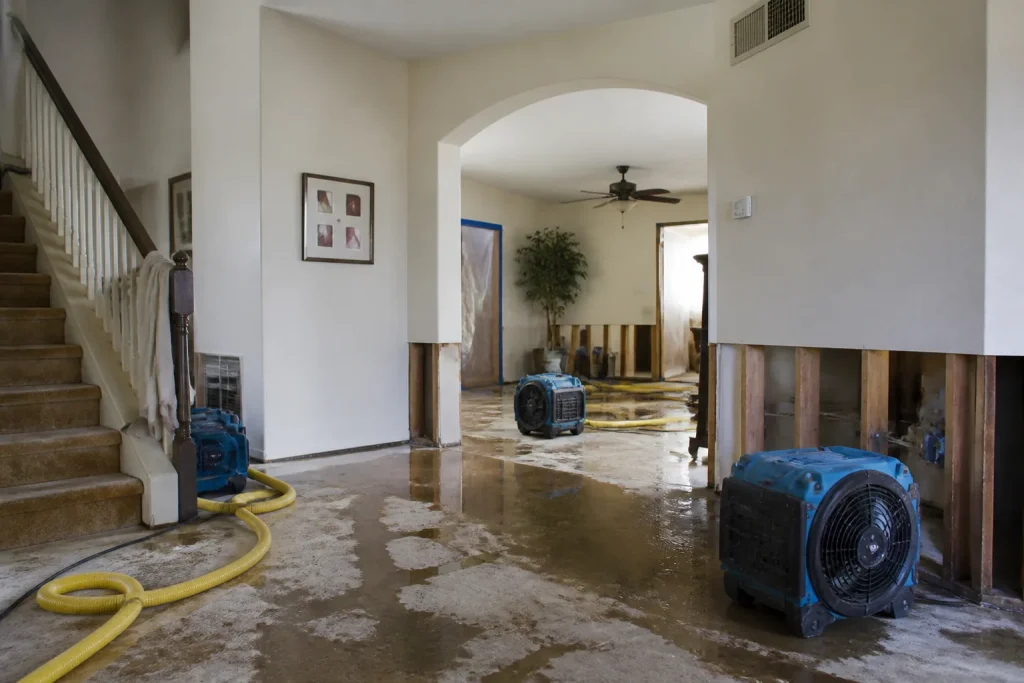
- Dehumidifiers: 1 – 2 units for a small room, 3 – 5 for larger areas or multiple rooms. Commercial-grade units we run (Dri-Eaz or Phoenix) pull 70 – 150 pints per day; consumer rental units pull half that and take twice as long.
- Air movers: 3 – 6 units placed to create focused airflow across wet drywall, flooring, and baseboards. XPOWER and B-Air units are standard workhorses here.
- HEPA air scrubbers: required during any Category 2 or 3 job to capture airborne contaminants disturbed during drying or demolition.
To audit whether your drying-day count was reasonable: a competent restoration company documents daily moisture readings and can show you the trend line. If equipment ran for 7 days but readings show materials hit dry standard on day 3, the extra days should be justified or credited. We give homeowners a written scope with anticipated drying-day ranges before we start, and we explain any extension as it happens.
3. Antimicrobial and Disinfection Treatment
Typical Fontana range: $300 to $1,200 depending on area size and water category.
Every Category 2 and Category 3 loss requires antimicrobial application to affected structural materials after drying. This is not a “spray and go” step; the product has to dwell on surfaces for the label-specified time, and the area needs ventilation afterward. This step is where Mold Remediation in Fontana overlap begins. Delaying or skipping antimicrobial treatment on a Category 3 loss means mold risk six weeks later, even if the structure reads dry at day 4.
4. Structural Drying Without Unnecessary Demolition
Typical Fontana range: $800 to $2,800 depending on wall and floor cavity access needs.
Here’s the part of the invoice most competitors won’t explain. Standard drying protocols involve pulling baseboards, drilling drywall weep holes, and sometimes removing lower drywall sections to force air into wall cavities. That’s effective but also creates repair scope.
When the water is behind tile, under cabinets, or inside a subfloor cavity, we deploy Injectidry panel systems: manifolds that force controlled low-pressure dry air directly into the cavity through small access points. The advantage is material preservation – the customer pays for drying, not for demolition and reconstruction of surfaces that could have been saved. In practice, a saturated subfloor under a $4,000 hardwood floor might cost $1,400 to dry in place with Injectidry versus $6,000 to tear out, rebuild, and refinish. That’s the kind of math that matters in Fontana’s mid-century ranch homes, where original hardwood floors are common.
5. Contents Manipulation and Pack-Out
Typical Fontana range: $500 to $3,000 for manipulation; $2,000 to $8,000 for full pack-out with offsite storage.
Content manipulation means moving furniture, lifting area rugs, relocating items to dry areas, and protecting belongings during the job. Most single-room losses fall into this category. A full pack-out, where a third-party contents contractor inventories, packs, transports, stores, and later returns your belongings, is a separate cost driver and the one homeowners are most often surprised by.
In Fontana, where many homes are single-story with garages, we can sometimes stage contents in the garage under plastic sheeting instead of sending them offsite. That saves thousands. Worth asking about when the estimate comes through.
Water Category and Why It Multiplies Cost
Water category is the classification the IICRC uses to define contamination level, and it changes the scope of work fundamentally, not just marginally.
- Category 1 (clean water): supply-line leaks, ice maker lines, hot water heater ruptures. Extraction, drying, minor repair. Lowest cost. Fontana homes with PEX repiping done in the last decade typically see this category.
- Category 2 (gray water): dishwasher discharge, washing machine overflow, sump pump failures. Antimicrobial required. Carpet pad typically replaced even if the carpet itself can be saved.
- Category 3 (black water): sewage, toilet backflow, outside floodwater. Full containment, controlled demolition, HEPA air scrubbing throughout, disposal of affected porous materials, personal protective equipment for technicians, and full antimicrobial application. Fontana’s older slab-homes with original cast-iron drains see more Category 3 events than newer subdivisions with PVC.
A Category 1 laundry room leak might cost $1,900 total. The same square footage with Category 3 contamination can run $5,500 to $9,000. The water didn’t do more damage; the contamination changed everything about the required scope.
Xactimate Pricing: Why Your Adjuster Cares About Line Items
When you file a homeowners insurance claim in Fontana, your adjuster works in a pricing language called Xactimate. It’s a third-party pricing database that assigns regional cost values to every restoration task, from “remove and dispose of wet carpet pad, per square foot” to “HEPA vacuuming, per square foot.”
A contractor who invoices in the same line-item format makes the adjuster’s job straightforward. The claim gets approved faster. The homeowner is less likely to owe out-of-pocket for items the policy should cover.
We write our scopes in Xactimate format for every insurable loss, even when the homeowner is paying cash, because the line-item structure gives the customer the clearest possible breakdown of what they’re paying for. No “water damage restoration: $8,500” with nothing behind it. You should see exactly how many square feet of drywall is being removed, how many drying days were billed, and what rate was applied for each piece of equipment. If a contractor won’t show you that, that’s a red flag.
One thing to know about Fontana claims: San Bernardino County code enforcement can require permits for structural repairs beyond what the mitigation work itself covers. A restoration involving drywall removal down to the studs and subfloor repair may trigger a permit requirement during the rebuild phase. That’s separate from the drying scope but shows up in the final invoice. Good restoration companies know which work triggers permits in this county and will flag it before work begins, not after the adjuster has closed the claim.
The Surprise Costs Fontana Homeowners Don’t See Coming
Here are the line items that catch people off guard, based on calls we take every week from Fontana homeowners.
- HEPA air scrubbing during demolition: Cutting into water-damaged drywall releases dust and potential mold spores into the air. The scrubber runs continuously during demolition and for 24 – 48 hours after. It’s not optional for Category 2 and 3 work. It adds roughly $150 to $350 per day to the job.
- Temporary containment: Building plastic barrier walls to isolate the work area from the rest of the home. Small rooms run $200 to $500. Multiple-room containment or full-floor containment goes higher.
- Contents pack-out with a third-party contractor: If the restoration scope exceeds what can be moved and staged in a garage, contents go to a warehouse. The cost is per cubic foot for packing, a monthly storage fee, and a return-and-unpack fee. On a large Category 3 loss, this can add $5,000 to $10,000 to the claim. It’s covered by most policies, but the homeowner needs to know the contractor isn’t padding the books here.
- Emergency service call after hours: Many companies charge a premium for dispatch between 6 p.m. and 7 a.m. We don’t charge extra for after-hours response on water losses, but it’s a legitimate question to ask up front.
We pulled one out of a garage over in the West End last month where a water heater had been leaking for three days before the homeowner found it. The garage slab had wicked moisture into the shared wall with the laundry room. By the time we got there, the drying scope had gone from “replace the water heater and dry the garage” to “open both sides of that wall, remove wet insulation, and set up containment.” The water heater cost $800. The restoration was $4,200, all because the water had time to migrate through the slab and into the wall assembly. Time matters more than most people think.
When to Call a Pro and When It Can Wait
If the water source is a clean supply line, the affected area is under 10 square feet, and you get to it within the first few hours with a wet-vac and fans, you might be fine without professional mitigation. Watch for any of these and call a pro immediately:
- Water has migrated under baseboards or into wall cavities.
- The water source involves sewage, toilet contents, or outside floodwater.
- You notice drywall bubbling, baseboard separation, or a musty odor within 48 hours.
- The affected area includes a subfloor or is under hardwood, tile, or cabinets.
- Anyone in the home has respiratory issues, and water has been sitting longer than 24 hours.
If you’re in Fontana and need to talk through your situation, our Water Damage Restoration in Fontana page explains our full process. We’re also set up for Fire Damage Restoration in Fontana when a water loss follows a fire suppression system activation, which we see more than people expect.
The Bottom Line
Water damage restoration pricing in Fontana follows four cost drivers: water category, affected square footage, drying days, and whether cavity drying equipment is actually deployed. Understanding those four things puts you in a position to evaluate any estimate with confidence. You should never be handed a single-line invoice without backup documentation. You should always receive a written scope before work starts. And you should always ask what your contractor’s drying standards are: “documented dry” means moisture readings that prove the job is done, not a visual once-over and a handshake.
If you’re in Fontana and need help, Dry Line Water Damage home is our main page, and we offer free estimates on water damage restoration. Call (833) 589-5317 and ask for a line-item scope on your loss. We’ll tell you what we find, what it costs, and what can wait. The estimate is free; the clarity is standard.
Frequently Asked Questions
A single-room, Category 1 water loss in Fontana typically runs $1,800 to $4,500 for full extraction, drying, and basic antimicrobial treatment in 2026. Category 3 or multi-room losses range from $5,500 to $15,000 or more depending on square footage, drying days, and structural demolition. Call (833) 589-5317 for a free estimate specific to your home.
Most standard homeowners policies cover sudden and accidental water damage, such as a burst pipe or water heater failure. Gradual leaks, lack of maintenance, and some roof-related water intrusion may not be covered. Restoration that follows a covered event, including drying and mitigation, is typically covered. We document everything and communicate directly with adjusters to protect the claim. Call (833) 589-5317 to ask about your situation.
A contained, single-room water loss in Fontana typically dries in 2 to 4 days with commercial-grade equipment. Wall cavities and larger affected areas run 4 to 7 days. Our daily moisture readings document the drying curve, and we apply industry-standard dry criteria before removing equipment, so you get a verifiable endpoint, not a guess.
An estimate is what the contractor thinks the work will cost. An insurance scope is the list of line items the adjuster approves for payment. We write our scopes in Xactimate format so the estimate and the insurance scope match, which speeds up claims and reduces out-of-pocket surprises for Fontana homeowners.
Written by the team at Dry Line Water Damage, serving Fontana since 2013.
Need Damage Restoration Help?
Call Dry Line Water Damage — licensed & insured, here with fast after-hours help in Fontana.
(833) 589-5317