How to Choose the Right Damage Restoration Company in Fontana
Choosing a restoration contractor in Fontana shouldn’t come down to who answers the phone fastest or who your insurance adjuster recommends. It should come down to verifiable credentials, equipment capability, and documented process, all of which a qualified company will be able to demonstrate before they start. If you’d rather skip the vetting process and talk to someone directly, call Dry Line Water Damage at (833) 589-5317.
Insurance companies have preferred contractor programs in Fontana that benefit the insurer’s cycle time, not necessarily your restoration outcome. Knowing that distinction before you sign an authorization form is worth several thousand dollars. Here’s what actually separates serious restoration operators from generalists chasing storm work.
Ask for IICRC Certifications by Name, Not Just “Certified”
Every legitimate restoration company in Fontana will tell you they’re certified. The question is certified for what, by whom, and does that certification match the damage you actually have? The IICRC (Institute of Inspection, Cleaning and Restoration Certification) issues specific credentials for specific disciplines. A technician holding a carpet cleaning certification is not qualified to dry out a flooded slab foundation, and saying “IICRC-certified” without specifying the credential is a red flag.
Here are the three certifications you should ask for by name when you’re dealing with water, mold, or fire damage in Fontana:
- WRT (Water Damage Restoration Technician) – This is the baseline credential for water extraction and structural drying. A WRT-certified tech understands psychrometry (how moisture moves through building materials), drying chamber setup, and moisture mapping. Without this, you’re hiring someone who is guessing.
- ASD (Applied Structural Drying) – This goes beyond WRT. An ASD-certified technician has demonstrated the ability to dry complex structures including wall cavities, subfloors, and multi-level buildings without unnecessary demolition. If your Fontana home has water trapped in a wall cavity or between floors, you want ASD on site.
- AMRT (Applied Microbial Remediation Technician) – This covers mold and sewage contamination. An AMRT-certified technician understands containment protocols, negative air pressure, and proper removal of contaminated materials without cross-contaminating the rest of the property. If you’re dealing with mold in Fontana’s summer heat and humidity, this matters.
The company should be able to produce copies of these credentials before you sign anything. We’re an IICRC-certified operation, and we keep documentation available because it’s the restoration industry’s most rigorous third-party standard for training and process. It means the techs on your job were tested on methodology, not just handed a van and a dehumidifier.
Ask this directly: “Which IICRC certifications do the technicians who will actually be on my job hold?” Then verify. Any hesitation is an answer.
Look at the Equipment Before You Sign
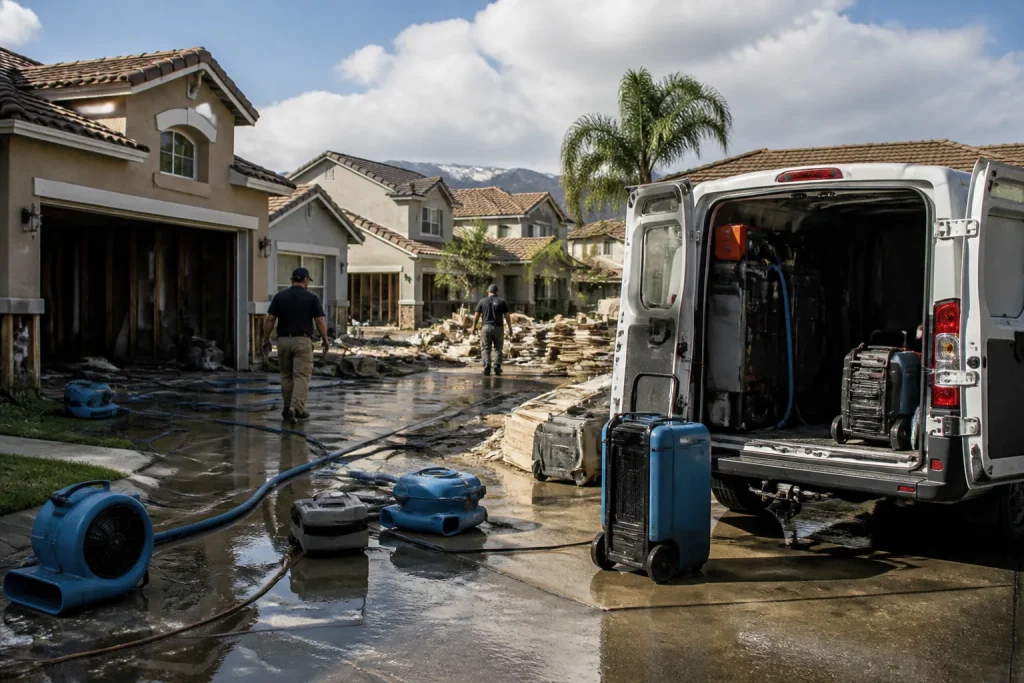
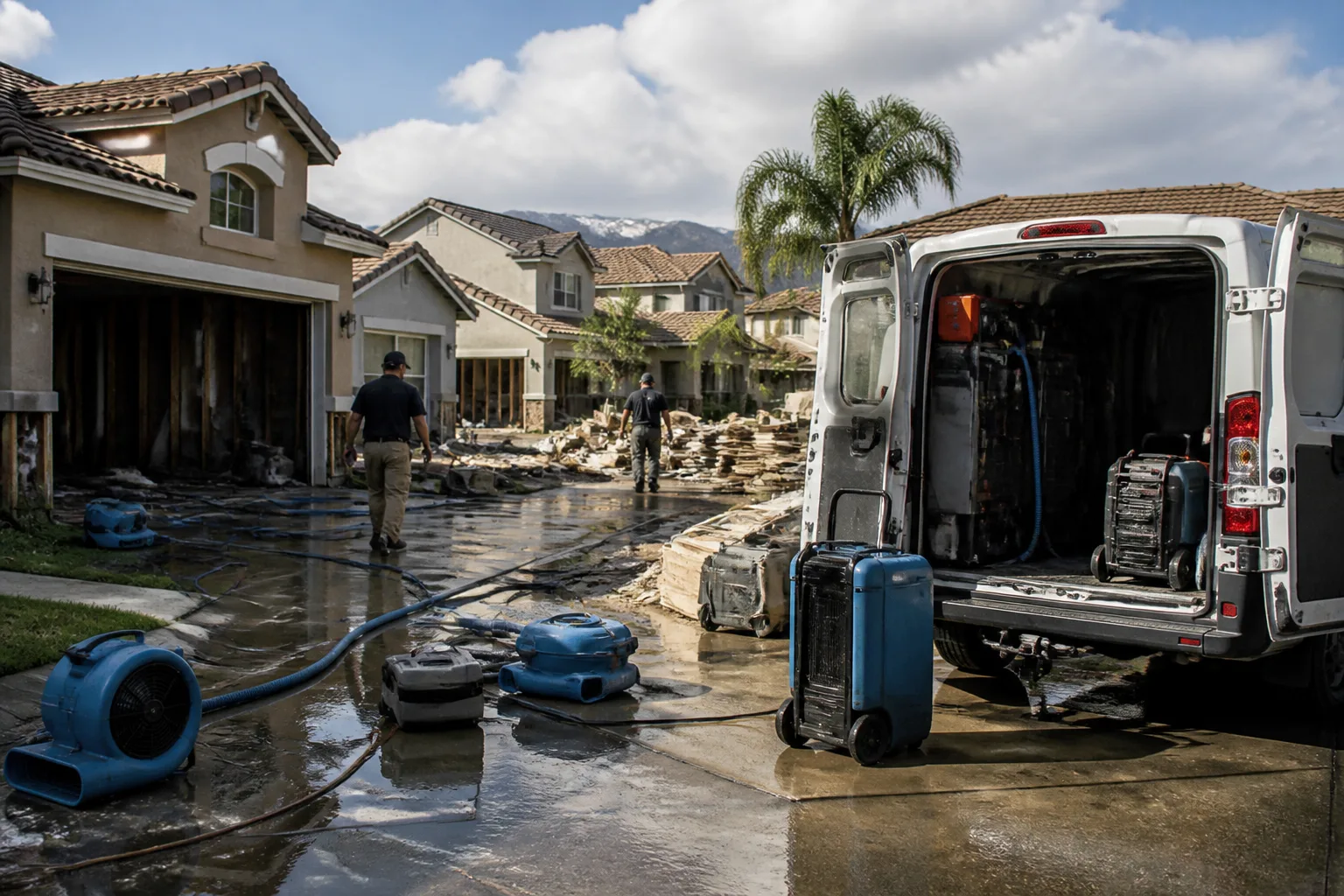
You can learn more about a restoration company in five minutes of looking at their truck than in an hour of reading their website. In Fontana, where summer temperatures regularly hit triple digits and homes are built on slab foundations with stucco exteriors, equipment capability is the difference between a property that dries in four days and one that grows mold behind the drywall.
A properly equipped water damage restoration company should be able to deploy:
- LGR (Low Grain Refrigerant) dehumidifiers – These pull moisture out of the air far more aggressively than the consumer-grade units you can rent at a hardware store. Commercial LGRs are what you need in Fontana’s climate, where ambient humidity plus evaporating water creates a perfect mold environment.
- Penetrating moisture meters – These read moisture content inside walls, not just on the surface. If a contractor shows up with only an infrared camera, that’s a visual tool, not a measurement tool. You need both.
- Thermal imaging cameras – Used properly, these show temperature differentials that indicate where water has migrated, including areas that look dry to the naked eye.
- Injectidry panels and mat systems – This is what separates serious operators from box-fan crews. Injectidry systems push dry air into wall cavities, under cabinets, and beneath flooring without tearing everything out. In our experience, this is the single biggest factor in reducing unnecessary demolition on water damage jobs in Fontana homes built in the 1990s and 2000s, where matching flooring and drywall texture after a tear-out adds weeks and thousands of dollars to a claim.
We run Dri-Eaz and Phoenix equipment on our water damage jobs. Those are the commercial-grade brands used on large-loss commercial restoration projects, not the rental machines you find at a big-box store. If the contractor who shows up at your Fontana house is unloading box fans and a wet vac, you are not looking at a restoration company. You’re looking at a cleaning crew with a marketing budget.
Understand the Preferred Vendor List Before You Trust It
When you file a claim for water damage in Fontana, your insurance company will likely offer a list of “preferred” restoration contractors. These are companies that have agreements with the insurer around pricing, billing, and timeline reporting. That’s not inherently bad. But it’s worth understanding what that agreement incentivizes.
Insurance preferred contractor programs are built around cycle time – getting the claim closed efficiently, which benefits the insurer’s cost structure. The contractor’s incentive is to keep the insurer happy so they stay on the list. Your incentive is a property that is actually dry, verified by moisture readings, with no residual mold three months later. Those incentives are not always aligned.
This doesn’t mean you should reject the insurer’s list. It means you should treat it as a starting point, not an automatic selection. Ask the preferred contractor these questions:
- “Are you billing the same scope you would bill if I were paying cash?” – If there’s a different scope for insurance work versus private pay, that tells you something about how the company approaches the job.
- “Who decides when the drying is complete – your technician or the insurer’s bill reviewer?” – The answer should be the technician, based on moisture readings, not a claims adjuster looking at photos in an office.
- “Will you provide me with a copy of the daily moisture log?” – A legitimate drying job produces documentation. If the company balks at sharing it, the documentation probably doesn’t exist.
One crew, full scope. That’s the standard. Water damage restoration in Fontana should not involve the extraction company handing off to a drying company that hands off to a mold company that hands off to a rebuild contractor. Every handoff is a gap where liability falls between chairs. Look for a contractor who handles the water, the mold, and the fire damage without subcontracting the core work.
Read the Estimate Line by Line Before You Sign
Restoration estimates are written in industry shorthand that most homeowners have never seen before. That’s not an accident. A vague estimate is easier to pad, and a padded estimate is a direct cost to you if your policy has a claim cap or if the insurer denies part of the scope.
Here’s what a legitimate drying estimate should include:
- Specific room-by-room scope – “Master bedroom, north wall, 12 linear feet of baseboard removal” is legitimate. “Dry affected areas as needed” is not.
- Equipment count and type – You should see specific numbers: “3 LGR dehumidifiers, 6 air movers, 1 Injectidry system, days 1-5.” If the equipment isn’t itemized, the billing isn’t transparent.
- Daily moisture reading schedule – A drying job should include daily readings and a target moisture content for the affected materials. If the estimate doesn’t mention moisture readings at all, that’s a red flag.
- Clear demo versus dry distinction – Materials that can be dried with Injectidry or similar methods should be listed separately from materials scheduled for removal. You should see a justification for every tear-out line item.
Vague line items to watch for: “General cleanup,” “Miscellaneous materials,” “Supervision,” or any percentage-based line item that isn’t tied to a specific task. These are placeholder line items that get filled in with whatever the contractor thinks the job will bear after the fact.
A legitimate drying day billing structure charges a documented rate per day based on equipment deployed and technician visits, with an end date tied to moisture content readings, not a calendar guess. If the estimate says “Day 1-3 drying” with no stop criteria, you’re signing an open-ended authorization.
Red Flags Specific to Fontana and the Inland Empire
Fontana sits in a desert-adjacent corridor where water damage comes in two flavors: the sudden, dramatic failures (supply line bursts, water heater failures, slab leaks) and the slow, humidity-driven problems (mold behind stucco, musty garages, damp crawl spaces). That creates a specific set of contractor red flags we’ve seen play out in neighborhoods from Northgate to Southridge to the area around Sierra Lakes.
Out-of-area storm chasers. After any significant weather event or freeze, contractors from Arizona, Texas, and even the Bay Area will work this market for a few weeks, then leave. The problem isn’t the travel. It’s the warranty. If a contractor dries your Fontana home and leaves the state, and mold shows up three months later, you’re handling that alone. Ask where the company is based and how long they’ve been operating in the Inland Empire.
Contractors who subcontract the drying work. Some companies are actually marketing firms that sell leads to independent drying crews. The company that signs your authorization form is not the company that shows up with equipment. Ask directly: “Are your technicians your employees, or are they subcontractors on this job?” If they hesitate, that’s your answer.
Demolition before moisture mapping. This is the one that costs Fontana homeowners the most money. A contractor shows up, sees wet drywall, and immediately starts cutting. What they should do first is map the moisture penetration with meters and thermal imaging to determine what actually needs to come out and what can be dried in place with Injectidry panels or negative air pressure. Demolition without moisture mapping is a contractor choosing the easy path over the correct path, and you pay for the rebuild.
We pulled one out of a garage over in the Southridge area a while back where the homeowner’s first contractor had quoted a full gut after a water heater valve failure. The moisture map showed water had wicked up one wall cavity and stopped at the fire break. We dried it in place with an Injectidry system and saved the homeowner about $11,000 in reconstruction. That’s the difference between a contractor who reads a room and one who reads a moisture meter.
When to Call a Pro
If the water has been sitting for more than 24 hours, if you can smell mold but can’t see it, if water has gotten under cabinets or into wall cavities, or if the damage involves sewage or fire residue, this is beyond DIY scope. The health and structural risks compound quickly. In Fontana’s summer heat, mold can establish in 24 to 48 hours on wet drywall, and once it’s inside a wall cavity, a homeowner-grade dehumidifier is not going to touch it.
Related services in Fontana: Water Damage Restoration in Fontana · Mold Remediation in Fontana · Fire Damage Restoration in Fontana
The Bottom Line
Choosing a restoration contractor in Fontana is a decision you’ll likely make under pressure, in the middle of a problem you didn’t create. That’s exactly when the vetting matters most. Ask for certifications by name. Look at the equipment. Treat the preferred vendor list as a starting point, not a decision. Read every line of the estimate before you sign. And if a contractor wants to start demolition before they’ve mapped the moisture, show them the door.
If you’re in Fontana and dealing with water, mold, or fire damage, we can walk you through the process and give you a straight read on what actually needs to happen. Dry Line Water Damage offers free estimates – call (833) 589-5317 and we’ll tell you what we’d do, documented dry, before you sign anything.
Frequently Asked Questions
Ask for the specific certification (WRT, ASD, AMRT) and the technician’s name. The IICRC maintains a public certification registry where you can look up individual technicians by name. If the company won’t provide the name, treat that as a red flag. A company-level “IICRC certified” claim tells you nothing unless you know which technicians on your job hold which credentials.
No. Preferred vendor status means the contractor has a billing agreement with the insurer. It does not mean they’re the best contractor for your specific situation. Use the list as a starting point, vet those contractors with the same questions you’d ask any other company, and remember that you are entitled to choose your own restoration contractor under California insurance law. Your insurer cannot force you to use their list.
Most structural drying jobs take three to five days when the right equipment is deployed. Variables include the volume of water, the materials affected, and how long the water sat before extraction. If a contractor tells you it will take two weeks to dry a standard supply-line failure in Fontana, they’re either under-equipped or padding the billing. Ask to see the daily moisture readings throughout the process.
Document everything with photos before anything is moved or cleaned. Shut off the water source if it’s safe to do so. Do not enter standing water that may be in contact with electrical. Move small valuables if you can do so without disturbing the affected area. And start making calls. The first 24 hours after a water loss in Fontana matter more than the next week, because mold colonization begins quickly in our climate. Call (833) 589-5317 and we’ll walk you through the immediate steps while you’re waiting for help.
Written by the team at Dry Line Water Damage, serving Fontana since 2013.
Need Damage Restoration Help?
Call Dry Line Water Damage — licensed & insured, here with fast after-hours help in Fontana.
(833) 589-5317