Emergency Water Damage Restoration Near Me: What Fontana Homeowners Should Do First
If you’re searching “emergency water damage restoration near me” in Fontana right now, stop what you’re doing and find your main water shutoff valve. The first 60 to 90 minutes after a supply line bursts, a water heater lets go, or an appliance hose fails are the only window where your actions materially change the restoration outcome. After that, the water has gone where it’s going, porous materials have absorbed what they’ll absorb, and the next 24 to 48 hours become a race against mold colonization and structural saturation. If you’d rather skip the scramble and have a crew on the way now, call (833) 589-5317.
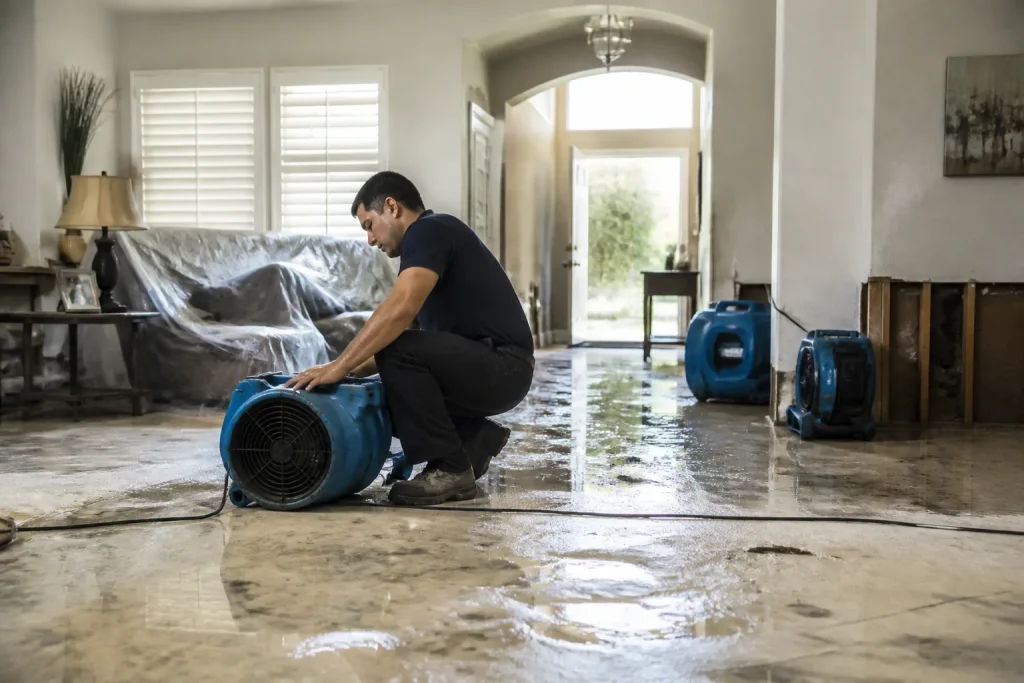
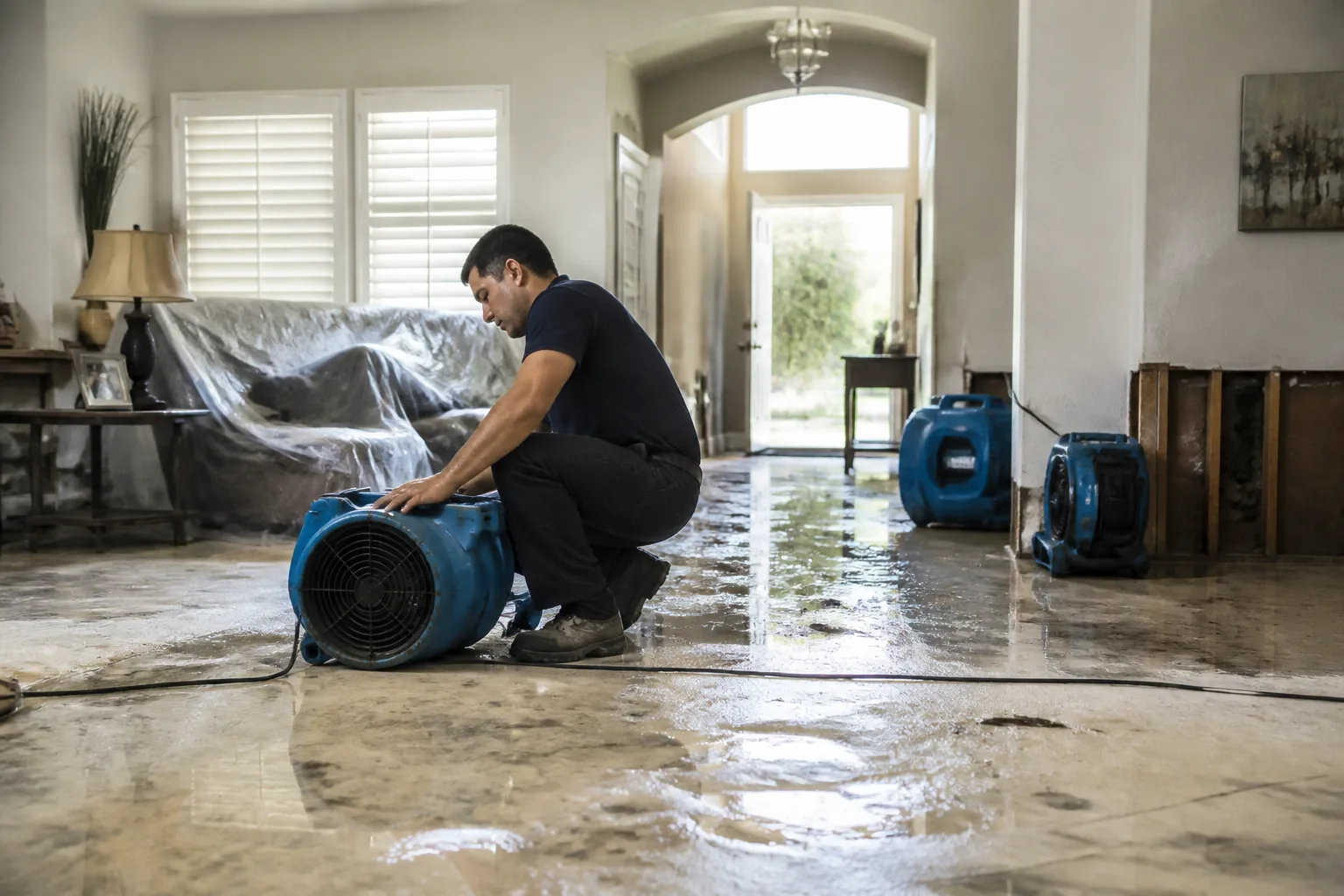
Most Fontana homeowners make the same mistake in that first hour. They grab every box fan in the house, aim it at the wet carpet, and crank the AC. Here’s the problem: that moving air isn’t drying anything yet. It’s distributing whatever was in the water, whether that’s soap residue from a washing machine overflow, sediment from a water heater tank, or worse, into the air and across surfaces that were never wet. By the time a restoration crew arrives, the contamination zone is larger than it had to be, and the remediation scope just grew with it.
We’ve been doing this work across Fontana long enough to know exactly how the first hour unfolds in most homes. This guide is a timed action sequence, not a generic checklist. It’s built around what actually matters: shutoff, documentation, containment decisions, and the phone call that gets the right equipment rolling.
Minutes 0 to 10: Kill the Water at the Source
Your first move in any Fontana water emergency is not mopping. It’s locating and closing your main water shutoff valve. In most Fontana homes, especially those built in the 1980s and 1990s sprawl eras, the valve sits on the exterior wall facing the street, often in a covered box near the hose bib. If you have a newer home in areas like Sierra Lakes or the Shady Trails developments, the valve may be inside the garage on the wall shared with the water heater.
Turn it clockwise until it stops. If the valve is corroded or won’t budge, don’t force it. A snapped valve stem at 2 a.m. turns a clean water loss into a flooded meter box that the city has to address. Instead, call the Fontana Water Company’s 24-hour emergency line and ask them to shut service at the curb. While you wait, do this:
- Open the lowest faucet in the house, usually a hose bib or a laundry sink, to relieve residual line pressure and give the standing water somewhere to drain.
- Shut off power to affected rooms at the breaker panel if water is anywhere near outlets, power strips, or beneath the wall line. Water and live circuits don’t negotiate.
- Move small furniture and rugs to dry ground only if you can do it without splashing through standing water. Wet shoes track contamination.
Fontana’s soil and slab conditions add a wrinkle here. Many neighborhoods sit on expansive clay, which is why most houses in this city are slab-on-grade rather than raised foundation. That’s good news for a supply line leak under a kitchen sink, since the water stays on top of the slab. It’s bad news for plumbing leaks inside or beneath the slab itself. Those move horizontally through the concrete, saturating walls and flooring 20 or 30 feet away from the visible puddle. If you see water in one room and moisture wicking into baseboards two rooms over, you’re likely dealing with a slab leak, not a simple overflow.
Minutes 10 to 30: Document Before You Touch Anything Else
The single most expensive mistake Fontana homeowners make in the first hour isn’t a DIY drying attempt. It’s not documenting the damage before moving furniture, pulling up carpet, or cutting wet drywall. Insurance adjusters assess scope based on visible evidence. Once carpet padding is ripped out and thrown on the driveway, that evidence is gone, and your claim just got harder to prove.
Here’s the documentation sequence that holds up to adjuster scrutiny:
- Wide shots first. Photograph every affected room from the entry door and from two additional angles, even if the room looks partially wet. These establish the perimeter of the loss.
- Waterline marks on drywall and baseboards. Shoot a close-up with a ruler or a coin in frame for scale. Waterline height tells the adjuster how much material needs replacement.
- Standing water depth and extent. If water is pooled, photograph it with a measuring tape or a yardstick showing depth. This matters because insurance categories depend on water depth and source.
- The source itself. The failed supply line, the split hose, the leaky water heater, the cracked toilet tank. Adjusters need to see the cause.
- Everything the water touched. Open cabinets, photograph the bottoms of vanities, show the underside of the washing machine, get the water heater closet. Hidden damage claims need photographic evidence to be approved.
Start a notes file on your phone. Log the exact time you discovered the water, the time you shut off the valve, and every restoration action you took after that. Timestamps matter. A documentation file with a clean chronology is the difference between a smooth claim and a drawn-out negotiation. This is the same standard we use when we walk a Fontana loss: photo-documented assessment before a single piece of equipment gets plugged in, and a written scope before any work starts.
Minutes 30 to 60: Containment Decisions You’ll Regret Skipping
By now the water has found its level. In Fontana slab-on-grade construction, that means water has seeped under baseboards, into wall cavities through the bottom plate, and beneath vinyl plank flooring where it will sit invisibly until the planks cup. Your containment decisions in this window should be specific and limited.
Move these items to dry ground:
- Small furniture pieces on legs, like accent tables and ottomans.
- Books, photo boxes, and anything paper-based within three feet of the visible perimeter.
- Electronics and their power cords, if you can reach them without stepping in standing water.
- Small rugs and floor mats that were only partially saturated. Bag them separately; don’t stack them on dry carpet.
Leave these in place until a restoration professional documents them:
- Wall-to-wall carpet and pad, including any portion you think is dry.
- Baseboards and drywall showing visible waterline.
- Large furniture pieces sitting in or near the water, especially upholstered pieces.
- Any item made of particle board, MDF, or engineered wood. Moving it while wet causes it to sag or crumble, and the adjuster needs to see it in place.
The instinct to “get everything out and start cleaning” is strong, especially when water is sitting in a room your family uses daily. Resist it. In Fontana, we regularly see losses where a homeowner pulled soaked carpet pad out to the garage to “dry it” before the adjuster could inspect. What they actually did was create a secondary mold source in an enclosed, warm garage, while simultaneously depriving their claim of its most important evidence. Wet pad comes out. But it comes out as part of a documented mitigation scope, not as a DIY sprint.
One more thing about this window: don’t run the HVAC system. Not for cooling, not for “drying.” Your air handler is now moving air through a duct system that may be pulling moisture from the affected area and distributing it throughout the house. In hot Fontana summers, the urge to keep the AC running while dealing with a water loss is strong. Shut it off until a restoration professional has assessed whether the ductwork is involved. The same goes for ceiling fans, bathroom exhaust fans, and any box fan. Moving air across contaminated water before proper extraction turns a contained Category 1 or 2 loss into a broader contamination event. That’s the upgrade that expands your remediation scope and your bill.
Minutes 60 to 90: The Phone Call That Determines What Arrives on the First Truck
When you call a water damage restoration company, the dispatcher is not just taking your name and address. A good dispatcher is building the deployment plan: what equipment goes on the first truck, how many technicians, what priority slot you get, and whether they bring containment materials or just extraction gear. The more specific you are, the better that first response looks.
Here are the four details to have ready when you call:
- The water source and whether it’s stopped. Say “supply line burst under the kitchen sink, main is shut off now” or “water heater tank split, water is still flowing, I need guidance on shutoff.” The second answer changes everything about how urgently the crew moves.
- How many rooms are visibly wet and whether water is wicking into walls. This tells the dispatcher whether the first truck needs extraction equipment, drying equipment, or both. A single-room overflow needs a different deployment than water that’s run through three rooms and into the hallway.
- Flooring types in the affected areas. Tile on slab is terrible for hidden migration. Carpet and pad need extraction. Hardwood is the one where every hour matters. Be specific: “engineered hardwood in the hallway and carpet in the two bedrooms.”
- Whether you’re filing an insurance claim. If you are, the restoration company needs to know before the first truck rolls. Insurance restoration requires photo documentation before demolition, moisture mapping for the adjuster, and a written scope that lines up with the policy language. A crew that doesn’t know about the claim will do the work, but the paperwork trail will be harder to reconstruct.
We send technicians into Fontana homes with industrial-grade extraction and drying systems: Dri-Eaz dehumidifiers, Phoenix air movers, and Injectidry structural-drying manifolds that pull moisture from wall cavities and under flooring without ripping everything out. The decision about which of those systems rides on the first truck gets made during that dispatch phone call. Give the dispatcher real information and the first response looks different.
What Fontana’s Slab Construction Means for Drying
Most Fontana homes sit on concrete slab foundations, unlike older neighborhoods in Riverside or San Bernardino where raised floors and crawl spaces are more common. That changes how water damage restoration works in this city, and it changes what you should expect from a restoration company.
On a raised foundation, water runs down through the flooring and into the crawl space or basement. That’s bad, but it’s visible. On a slab, water can’t go down, so it travels horizontally. It migrates under baseboards, wicks up into the bottom of drywall, and channels through any low spot in the slab, which in Fontana is often the hallway, the bathroom floor recess, or the seam between the slab and the garage floor. By the time a slab leak shows up as a wet patch on the carpet, the water may have been moving underneath for days or weeks.
The containment approach is different too. On a slab, extraction is critical, but the real challenge is drying the wall cavities and the underside of flooring materials that are trapping moisture against the concrete. That’s where Injectidry systems earn their keep. Instead of cutting drywall out at knee height to “let it air out,” Injectidry creates a vacuum-driven drying path that pulls moisture out of the cavities through the existing structure. In slab-on-grade construction, that’s the difference between removing a 12-inch strip of drywall along the bottom of every affected wall versus removing entire wall sections. Less demolition means less reconstruction, which means a shorter claim and a faster return to normal life in a Fontana home.
If a restoration company shows up with a couple of consumer-grade rental fans and a meter that only reads surface moisture, the drying process will not hold up on slab construction. You need moisture mapping that penetrates into the wall cavities and the subfloor, plus equipment that moves enough air volume to dry from the inside out. We pulled a loss out of a garage on the north side of Fontana a few years back where the previous company had dried the visible puddle and declared the job done. Six weeks later the baseboards were swelling and the homeowner had mold behind the drywall. The moisture had migrated along the slab and never been touched.
When to Call a Pro (And When You Can Handle It Yourself)
Small, clean water sources can sometimes be handled without a restoration crew. A dripping supply line that you caught within minutes, water confined to a non-porous tile floor, no drywall contact or baseboard wicking, and you have the time to extract and run commercial drying equipment for 72 hours. That is a rare scenario. It is not the scenario most Fontana homeowners are dealing with at 11 p.m. on a Tuesday.
Call a professional restoration company if any of these are true:
- Water has reached drywall, baseboards, or any wall cavity. Sheetrock is a sponge. It wicks moisture up and inward and it does not dry on its own.
- The water source is anything other than clean supply water. Washing machine overflow? Dishwasher? Water heater? That’s not pure water and it needs extraction and disposal protocols that a shop vacuum cannot provide.
- Water has sat for more than 24 hours, or the temperature is above 70 degrees. In Fontana, that’s most of the year. Mold colonization begins in 24 to 48 hours in warm, damp conditions.
- You suspect a slab leak. Visible water one place and warping floors elsewhere is a structural moisture issue, not a spill.
- You’re filing an insurance claim. Professional documentation, moisture mapping, and a written scope are what make the claim reimbursable.
Related services in Fontana: Water Damage Restoration in Fontana is the primary emergency response. If water has sat long enough for mold to establish, Mold Remediation in Fontana is a connected scope we handle without handing it off to a separate vendor. And if the water loss came from a failed appliance or electrical issue that led to fire, Fire Damage Restoration in Fontana is part of the same integrated response. One crew, full scope, no coordination gaps.
You can also read more about our overall approach on the Dry Line Water Damage home page.
How We Document a Fontana Water Loss for Insurance
Since insurance is almost always in the room, even when nobody’s said it out loud yet, the documentation standard matters. A restoration company that does not document properly is not doing you a favor by moving fast. They’re setting up a claim dispute down the line.
Here’s what our documentation process looks like on a typical Fontana water loss, and what you should expect from any company you call:
- Moisture mapping before extraction. We use penetrating and non-penetrating moisture meters to establish the full perimeter of affected materials, including areas behind walls and under flooring that show no visible signs yet. This map goes to the adjuster.
- Photo documentation before demolition. Wide shots, close-ups, waterline marks, and material cross-sections as needed. Every cut, every removal, every disposal is photographed and logged.
- Daily drying logs. Moisture readings taken at the same reference points every 24 hours, showing the progression from wet to dry. “Documented dry” means the numbers say dry, not that the surface feels dry.
- A written scope before work starts. You know exactly what’s getting extracted, what’s getting removed, what’s getting dried in place, and why, before the first cut is made. No surprises, no upsells after the fact.
Direct adjuster coordination is part of the job. We’ve sat across from adjusters on hundreds of Fontana claims, and a well-documented water loss is a non-event. The claim gets processed, the scope gets approved, the work gets done. The nightmare stories you hear are almost always about undocumented work, scope creep, or a company that walked off the job before the structure was actually dry.
The Bottom Line
The first 90 minutes after a water loss in Fontana are not about drying anything. They’re about shutting off the source, documenting the damage while it’s still visible, containing the contamination without spreading it, and making a phone call that gets the right equipment dispatched. After that, the professionals take over, and the quality of your first hour shows up in the quality of your final result.
If you’re in Fontana and staring at standing water right now, skip the fans and the towels. Call (833) 589-5317 for a free estimate. We’ll walk you through shutoff, document the loss while it’s fresh, and bring the same commercial-grade systems, Phoenix and Dri-Eaz equipment, and documented-dry process we use on every loss, from single-room overflows to full-structure events. The sooner you call, the less there is to fix.
Frequently Asked Questions
Most water damage restoration calls in Fontana are responded to within 60 to 90 minutes, depending on call volume and time of day. The dispatcher uses the details you provide, including water source, affected rooms, and flooring types, to prioritize urgency and load the truck correctly. Call early, before the water has had time to migrate along the slab and into wall cavities.
Most homeowners policies cover sudden and accidental water discharge from supply lines, water heaters, and appliances. Coverage depends on the source, the age and condition of the failed component, and whether the loss qualifies as sudden versus gradual. A restoration company that documents the loss properly, with moisture mapping and time-stamped photos before any demolition, gives your claim the best chance of full reimbursement.
No. Running HVAC, box fans, or ceiling fans across standing water spreads moisture and any contaminants in that water throughout the house, including rooms that were never wet. That can upgrade a contained loss into a broader contamination event and increase the remediation scope. Shut off the HVAC system and leave the drying to extraction and commercial-grade dehumidification equipment.
If water has reached drywall, baseboards, wall cavities, or any porous flooring material, a shop vac will not resolve the loss. Water trapped inside walls and under slab-adjacent flooring requires penetrating moisture meters and structural drying equipment to reach. Surface dry is not documented dry. Fontana’s slab construction means invisible moisture migration is more likely here than in raised-foundation homes.
Written by the team at Dry Line Water Damage, serving Fontana since 2013.
Need Damage Restoration Help?
Call Dry Line Water Damage — licensed & insured, here with fast after-hours help in Fontana.
(833) 589-5317