Last updated October 31, 2026
 Water damage drying
 Fire & smoke cleanup
 Mold remediation
 Storm response
 Sewage cleanup
 Reconstruction
Free visual inspection and a written scope of work before any mitigation begins - photos, moisture readings, and drying logs go in your claim file
The scope we write is the scope we bill. Anything new gets shown to you, in writing, before we touch it.
Get your free estimateDamage Restoration Emergency Preparedness Guide for Fontana Homes
Mold colonization in Fontana’s summer interior temperatures can begin in as little as 24 to 48 hours after a water event. That timeline means the decisions you make in the first hour after discovering damage are more consequential than anything a restoration crew does on day two. This guide gives you a documented, step-by-step response protocol for water events in Fontana homes, and you can find more guides & resources on our blog. You’ll learn what to do in the first 60 minutes, what not to do under any circumstances, how to document damage before extraction begins, how to pre-qualify a restoration contractor before you need one, and which Fontana utility contacts belong in your emergency binder. We’ve built this from years of responding to water, mold, and fire losses in Fontana, and we’ve structured it so you can execute it correctly even when you’re stressed and the clock is running.
Quick Answer
Emergency preparedness for water damage in Fontana means having a written, practiced response sequence that you can execute correctly within the first hour, because that window determines whether you get a contained drying project or a mold remediation claim. The three non-negotiable first actions are: shut off the water source, kill power to affected areas at the breaker, and document everything with photos and video before touching anything. After that, call a restoration contractor who can arrive with industrial-grade equipment and an IICRC-certified process to document the dry-out to a verifiable standard.
Restoration work we handle
Table of Contents
- The 60-Minute Water Event Response Sequence
- How to Locate and Document Every Water Shutoff in a Fontana Home
- What to Photograph and Document Before Extraction Begins
- How to Pre-Qualify a Restoration Contractor Before an Emergency
- The Fontana Home Emergency Binder: Utility Contacts and Shutoff Protocols
- The Mold Timeline in Fontana’s Climate: Why 48 Hours Is Your Hard Ceiling
- Structural Drying: Why Surface Moisture Tests Do Not Mean Dry
- Documentation and Insurance: How to Protect Your Claim Before the Adjuster Arrives
The 60-Minute Water Event Response Sequence
Water events split into two categories: clean water (Category 1) from a supply line, and contaminated water (Category 2 or 3) from appliances, sewage backups, or outside flooding. Your first 60 minutes look different depending on which one you’re facing. Here is the sequence we walk Fontana homeowners through when they call us during an active water event.
- Stop the water source. This means closing the fixture shutoff, the appliance valve, or the main. Do not waste time looking for the source if water is pouring from a ceiling or wall cavity. Go straight to the main shutoff, close it, and then investigate. In most Fontana homes built in the last 20 years, the main shutoff is near the water meter or where the service line enters the garage. In pre-1990 slab-on-grade construction, it may be in a wall box near the water heater. Know this location before you need it. The section on shutoffs below tells you how to map every valve in your house.
- Kill power to affected rooms at the breaker panel. Water and live circuits do not mix. If water has pooled near outlets, baseboard heaters, lamps, power strips, or appliances plugged into the wall, trip the breakers for those rooms. Label the affected breakers before you trip them so you don’t create more confusion later. If the panel itself is wet or you can’t reach it without standing in water, leave it and call an electrician after you’ve called a restoration company. This is a hard rule: water-conducted electricity kills faster than most people assume.
- Stop the HVAC system if the water is or could be contaminated. This is one of the most common mistakes we see in Fontana homes. If the water is from a sewage backup, washing machine discharge, toilet overflow, or outside flooding, running the air handler will pull contaminated moisture into the return air, pressurize it through the ductwork, and distribute it into every room of the house. A Category 2 or 3 water event becomes a whole-house contamination problem in under 10 minutes when the HVAC runs. Shut the furnace or air handler off at the thermostat, then trip the furnace breaker for good measure. If the water is clean and the HVAC intake is dry and far from the affected area, running the system on fan-only can help air movement, but that call is better left to a technician who can see the full picture.
- Contain what you can without exposing yourself to the source. For clean water, use towels, blankets, or anything absorbent to dam doorways and slow migration into adjacent rooms. For contaminated water, do not handle materials by hand. Block off the affected area, keep family members and pets out, and wait for professional extraction. If the electrical panel is accessible and dry, cutting power to the affected zone is your primary containment action for contaminated water.
- Photograph everything before you move anything. The next section of this guide covers this in detail, but the rule is simple: you take pictures now, you document the water level, the materials touched, the source, and the time. This is the evidence that protects your insurance claim. It takes five minutes and costs nothing.
- Call a restoration contractor who can start extraction quickly. If you wait until the water has been sitting for 36 hours and the drywall is wicking moisture four feet up the wall, you’ve changed the scope of the job significantly. Call someone who answers the phone, asks the right questions, and can tell you what to do next while they dispatch a crew. Our team at Dry Line Water Damage home walks homeowners through this sequence in real time. If you already have a contractor pre-qualified from the section below, you make this call from a position of information, not panic.
Sixty minutes may not seem like much time, but the sequence above is executable in 20 minutes once you know your shutoff locations. The homes where we see the worst outcomes are the ones where the water source ran for hours, the HVAC kept cycling, and no one documented the scene before the mop came out.
How to Locate and Document Every Water Shutoff in a Fontana Home
You cannot execute a 60-minute response if you don’t know where the water stops. Fontana’s housing stock spans 1940s bungalows, 1970s ranch homes, 1990s track developments, and 2010s two-story suburban builds, and shutoff locations vary across all of them. The standard is this: every water-using fixture and appliance in your home has its own isolation valve, and the whole house has a main. Find all of them now, not during an active leak.
Start with the main shutoff. It sits where the water service line enters the house, which in most Fontana homes is in one of four locations: the garage wall facing the street, a ground-level wall box near the water heater, an exterior wall box near the meter, or a crawlspace foundation wall in older homes. The valve is usually a gate valve (round handle, several full turns) or a ball valve (lever handle, quarter turn). Ball valves are preferred because they don’t seize and they close with a single turn. If your main is a gate valve and it’s older than 15 years, test it twice a year. A gate valve that hasn’t been cycled in years can seize open, and that failure surfaces exactly when you need a shutdown most.
Next, map the fixture-level stops:
- Toilets: The shutoff is a small chrome or plastic angle stop on the wall behind the bowl, low, near the baseboard. Turn it clockwise to close. Test it once a year.
- Bathroom and kitchen sinks: Look under the sink for two smaller angle stops, one hot and one cold. These are often the first to corrode in Fontana homes due to the mineral content of the local water supply, so cycle them gently and replace any that leak or won’t turn.
- Washing machine: Most homes have a recessed box behind the washer with two valves. If your home predates that standard, the valves may be on the wall above the machine. Label the hot and cold sides now while they’re dry.
- Water heater: There is a dedicated cold water shutoff on the supply line feeding the top of the tank. In a water heater failure, this is the valve that stops the feed. The tank drain valve is a different fitting at the bottom and is not a substitute.
- Dishwasher: Some dishwashers have a dedicated shutoff on the hot water line under the adjacent sink. Others are spliced off the sink hot water feed. If you can’t identify a dedicated valve, the under-sink hot water stop will usually cut supply.
- Refrigerator water line: Often a saddle valve with a small plastic handle on the copper or plastic line running to the fridge. Saddle valves are notoriously failure-prone, and we’ve seen more leaks start at these fittings than any other single appliance point in Fontana kitchens.
- Outdoor hose bibs: They freeze less here than in colder climates, but the internal washers and packing wear out. Shut them off at the interior isolation valve during the cooler months and drain the line.
- Landscape irrigation: This is a separate system with its own backflow preventer and shutoff, usually near the main water service or in an underground valve box near the house. In many Fontana homes, the irrigation main is upstream of the house main, so a landscape leak can keep feeding even after the house main is closed. Know this now.
Once you’ve found every valve, make a one-page sketch or a printed sheet with each shutoff location marked by room and fixture. Put that sheet in your emergency binder and take a phone photo of it too. A valve you found six months ago and memorized is not the same as a labeled map when water is pouring through a ceiling and you can’t think straight.
What to Photograph and Document Before Extraction Begins
Insurance adjusters look for a documented timeline. Your claim gets stronger when the record shows what the damage looked like before anyone moved furniture, mopped water, pulled up carpet, or cut drywall. In our experience on Fontana claims, the single most valuable step a homeowner can take in the first hour is a methodical phone-photo sweep. It costs nothing and it protects you from disputes about cause, scope, and pre-existing damage later.
Here is the documentation sequence we recommend before you touch anything:
- Wide shots from every angle first. Take a photo from each doorway looking into the affected room. Capture the entire room, the water path, and any visible standing water. These wide frames establish context for the close-ups that follow.
- The water source. Photograph the leaking pipe, the blown supply line, the failed water heater fitting, or the backed-up drain. If the source is inside a wall cavity, photograph the visible access point and any water escaping from it.
- Standing water depth and extent. Place a coin, a tape measure, or anything with a measurable reference next to standing water and photograph it. If water has spread across multiple rooms, photograph each room’s floor so the full migration path is documented.
- Materials that are wet. Photograph the baseboards, drywall, flooring material, cabinetry, and contents that show visible wetness. The adjuster will compare the dry-out record against this initial damage photo. If something was wet on day one and is not in the photos, the claim scope shrinks.
- Visible staining, wicking, or discoloration. Wet drywall wicks upward. In Fontana’s inland climate, the wicking line is often visible as a darker band above the water line. Photograph that line. It shows how long the water sat and how far it migrated.
- Serial numbers and tags. For water heater failures, major appliance ruptures, or equipment-caused damage, photograph the unit’s serial number and model plate. This matters for subrogation when the insurer pursues a manufacturer.
- Your electrical panel, if it’s dry and safe. Photograph the breaker positions before you trip them off. This shows which circuits served the affected area and prevents confusion about what was energized when the damage occurred.
- A dated time stamp. If your phone doesn’t auto-stamp, take a photo of your phone’s lock screen or a wall clock in the frame. The sequence of events matters to an adjuster.
This documentation belongs in your own cloud storage and should be shared directly with your restoration contractor. A good restoration project starts with a photo inventory, a written scope, and a documented initial moisture map. That record is the baseline the entire dry-out is measured against. For Fire Damage Restoration in Fontana, the documentation sequence is different but the principle is the same: photograph every surface before anything is moved, cleaned, or demolished.
How to Pre-Qualify a Restoration Contractor Before an Emergency
The worst time to research a restoration contractor is at 2 a.m. with water running down a hallway. Fontana homeowners who call from a position of information make better decisions and get better outcomes. Pre-qualification means you’ve already vetted one or two firms, verified their credentials, and saved their number in your phone. Here’s what to look for.
First, check the certification. IICRC certification is the restoration industry’s most rigorous third-party standard for training and methodology. It is not a self-issued credential. A firm that operates an IICRC-certified process has committed to documented drying standards, not just visual inspection. Ask the company which IICRC categories their technicians hold: water damage restoration, applied structural drying, and mold remediation are the three relevant ones for a Fontana water loss.
Second, ask what equipment they run. This matters more than most homeowners realize. Consumer-grade dehumidifiers and rental carpet fans will not pull moisture from wall cavities, under flooring, or from structural framing. Professional restoration companies run commercial gear: Dri-Eaz and Phoenix dehumidifiers, high-volume air movers, and Injectidry structural drying systems that actively draw moisture from inside walls and under floor systems without unnecessary demolition. One of our Water Damage Restoration in Fontana projects changed scope entirely because the homeowner’s first assessor only checked surface moisture readings with a pin meter. The wall cavities still held elevated readings 10 days later. The right equipment makes the difference between documented dry and apparently dry.
Third, ask about the documentation standard. A contractor should provide a written scope before work starts, a moisture map recorded daily or per visit, and a final verification log showing the dry standard was met, not assumed. If a company can’t tell you what dry standard they document against (it should be an IICRC S500 reference for water damage), keep looking.
Fourth, ask about the full scope. A water damage event in Fontana can create the conditions for mold growth in 24 to 48 hours. A fire damage event involves water from suppression plus soot and smoke residue. You want a restoration partner with three integrated disciplines under one roof: water damage mitigation, Mold Remediation in Fontana, and Fire Damage Restoration in Fontana. That way one accountable team handles the full loss scope without the coordination gaps and liability finger-pointing that come with hiring separate vendors. RIA membership is another good signal. The Restoration Industry Association requires adherence to a published code of ethics and industry best practices.
Pre-qualification is not a one-time task. Re-verify once a year. Make sure the phone number still works, the company is actively operating, and their certifications haven’t lapsed. Save the number under a name you’ll remember at 2 a.m.
The Fontana Home Emergency Binder: Utility Contacts and Shutoff Protocols
Every Fontana home should have a physical emergency binder with utility contacts, shutoff locations, and the correct first-call sequence. This binder sits in a known location. You can build it in an afternoon. The day it matters, you won’t have time to search for it.
Here is what belongs in the binder, tailored for Fontana residents.
- Water emergencies: The City of Fontana Water Company or the Fontana Water Company service line handles water main leaks outside the house, while everything from the meter to your fixtures is your responsibility. The Utility Billing Department at City Hall is the starting point for billing questions and service interruptions. For after-hours water emergencies in the public system, the city’s public works answer line coordinates with the water division. Write down the number for your specific water provider. Fontana is served by multiple water districts depending on your address, so pull your most recent bill and note the correct emergency line for your service area.
- Electricity: Southern California Edison (SCE) serves most of Fontana, with some pockets served by the Fontana Power Authority for municipal accounts. SCE’s outage reporting line handles downed lines and service interruptions. For anything inside the panel or downstream of the meter, you’re calling a licensed electrician, not the utility.
- Gas: Southern California Gas Company handles gas leaks and gas service. If you smell gas or suspect a gas main leak, evacuate and call the Gas Company’s emergency line from outside the house, then call the Fontana Fire Department. The main gas shutoff at your meter is a valve on the pipe feeding up from the ground. It requires a wrench to turn a quarter turn to the off position. In Southern California Gas Company territory, the rule is simple: if you shut off the gas yourself during an emergency, only a qualified professional can safely relight and test the system after the emergency passes. Write that rule in the binder.
- Non-emergency City of Fontana lines: Code enforcement for unpermitted work or substandard housing, building and safety for permitting questions after a structural loss, and the public works department for storm drain or sewer main issues. These numbers should be written down, not bookmarked on a phone that might be dead.
- Your insurance carrier’s 24-hour claims line plus your policy number and a written note instructing whoever finds the binder to call this number after the restoration company has been contacted. Filing the claim early is good. Filing it with a restoration contractor already on-site is better because they can document the initial scene alongside the adjuster’s visit.
- Your pre-qualified restoration contractor’s number. This goes first, before the insurance line, because a documented response starts the moment you call someone who can extract water and begin the dry-out. The restoration company should be reached before or at the same time as the insurer, never after.
- Your mapped shutoff locations. The one-page sketch described in the shutoff section above, laminated or in a sheet protector.
- IBEW and local trade hall contacts. If your Fontana home was built or rewired by IBEW-affiliated electricians, you can call the local IBEW referral program for a list of licensed electricians bound to the union’s standards. This is not a utility number, but it belongs in the binder for any electrical work required after a damage event.
The binder should be reviewed twice a year. Numbers change. Utility service areas shift. A binder built in 2021 contains at least one dead line in 2025 if it hasn’t been refreshed.
The Mold Timeline in Fontana’s Climate: Why 48 Hours Is Your Hard Ceiling
Fontana sits in the Inland Empire, where summer interior temperatures routinely hold in the 80s even with air conditioning cycling. That heat, combined with the moisture trapped behind drywall and under flooring after a water event, creates the exact conditions mold needs to germinate. IICRC reference materials and the EPA both point to a 24 to 48 hour window before visible colonization begins on wet organic surfaces. In Fontana’s summer conditions, the shorter end of that range is the realistic one.
This is why the 60-minute response sequence matters. If you find standing water at 6 p.m. on a July evening and wait until the next afternoon to start extraction, you’re already inside the germination window. By day three without structural drying, you’re not managing water. You’re planning mold remediation, and that’s a different project scope with different containment requirements.
The materials in your home determine the timeline as much as the climate. Drywall, carpet pad, and unsealed wood framing are organic and highly absorbent. Once they’re saturated, they hold moisture in cavities and behind surfaces where air movement from a fan won’t reach. Surface moisture readings drop while the wall cavity stays wet. We’ve seen Fontana homes where flooring registered dry on the surface while the subfloor held 25 percent moisture content underneath. That’s the environment that produces hidden mold colonies inside weeks.
The containment strategy for fontana homes is not complicated: stop the water, extract what you can, and get structural drying started inside the first 24 hours. The margin for error shrinks with every hour past that. A home in Fontana’s dry inland air in October has a slightly longer window than one in August, but neither is long enough to justify waiting to see how things dry on their own.
Structural Drying: Why Surface Moisture Tests Do Not Mean Dry
Most Fontana homeowners we talk to assume a water damage project is done when the floor feels dry and the baseboards look fine. That assumption causes more re-opened claims than any other single factor. Surface moisture meters only read the material they touch. They cannot tell you what’s happening inside a wall cavity, under a tile floor, between floor joists, or behind built-in cabinetry.
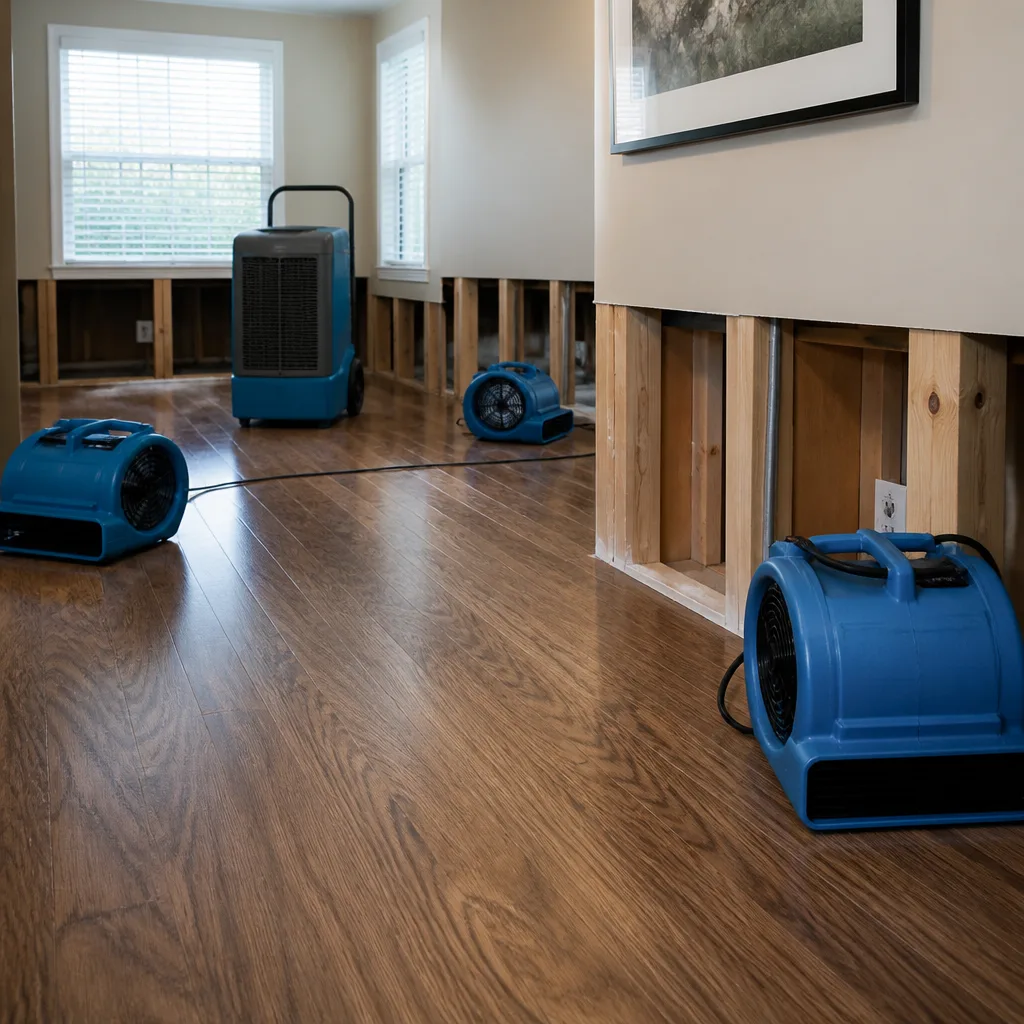
Structural drying means manipulating the environment so that moisture held inside building materials moves into the air, where dehumidification can pull it out. It requires measured input: air movement in the right volume, dehumidification capacity matched to the water load, temperature control, and specific placement of drying equipment. Industrial-grade systems like Dri-Eaz and Phoenix dehumidifiers are built for this work, with the capacity to extract gallons of water per day from the air. XPOWER air movers create the air flow patterns that pull moisture from wet surfaces into the drying air stream. These are not consumer rental machines. They move dramatically more air and pull dramatically more moisture.
Injectidry systems take this a step further. Instead of relying only on air movement across surfaces, Injectidry panels and channels attach directly to wall cavity access points and floor systems, creating negative pressure that actively draws moisture from inside the structure. This is what makes structural drying without unnecessary demolition possible. Instead of cutting out drywall to dry a wall cavity, a technician can drill small injection points, attach the Injectidry system, and pull the moisture out through controlled airflow. The material stays intact, the repair scope shrinks, and the drying is verifiable with daily moisture readings.
Documented dry means the project ended because measurements confirmed the structure returned to a dry standard, not because someone visually decided it looked okay. That standard comes from IICRC S500, the industry reference for professional water damage restoration. A scope that includes daily moisture mapping, logged equipment runtime, and final verification readings against a dry standard is the difference between a restoration project and a dehumidifier rental. In our experience on Fontana jobs, the homes that get documented dry stay dry. The homes that get surface-tested and closed reopen with problems six weeks later.
Documentation and Insurance: How to Protect Your Claim Before the Adjuster Arrives
The insurance process for a water damage loss in Fontana begins long before the adjuster shows up. The documentation you capture in the first hour, the contractor you bring in, and the written scope you get before any work starts all shape the claim outcome. Here is what matters most.
First, your restoration contractor should work directly with the adjuster. You do not need to translate moisture readings into insurance language. A restoration company that routinely handles claims knows how to present a documented loss in the format adjusters expect: initial moisture mapping, photo documentation, daily drying logs, equipment placement records, and final dry verification. That documentation supports the claim scope and prevents disputes about what was and wasn’t wet.
Second, photo-documentation before anything is moved matters more than almost anything else because it preserves the baseline the claim is built on. The adjuster arrives hours or days after the event. They see the post-extraction scene, not the initial water level. If your first-hour photos don’t exist, the adjuster reconstructs the loss from what they can see. That reconstruction is always smaller than what happened.
Third, understand the restoration company’s role. They are not public adjusters. They don’t negotiate your settlement. What they do is document the damage to a professional standard and communicate the scope directly with the adjuster’s office. When both sides speak the industry’s language, claims move faster and disputes are less common. That’s the practical benefit of hiring a firm with IICRC-certified processes and RIA membership rather than a generalist handyman who carpets the gap with informal notes.
Fourth, keep your own records. Every phone call with the insurer, every document from the restoration company, every photo you take. Put it all in a folder, digital or physical. The person holding the best records has the strongest position. That person should be you.
Common Mistakes to Avoid
- Running the HVAC system after a contaminated water event. This aerosolizes Category 2 and 3 water from sewage or appliance backflows and distributes it through the entire duct system. Once those contaminants are in the ductwork, the remediation scope expands from one room to the whole house.
- Using a shop vac and box fans instead of calling a professional. Retail-grade equipment cannot reach the moisture in wall cavities or under flooring, and the drying it produces is superficial. The project looks dry on the surface while structural material remains saturated underneath.
- Waiting to file the insurance claim until after you see the repair bill. Most policies require prompt reporting, and the longer you wait, the harder it is to establish a clean timeline of cause and scope. Call your restoration contractor first, then file the claim the same day.
- Pulling up carpet or cutting drywall yourself before documentation. You may be destroying the evidence the adjuster needs to establish the water’s path and the full scope. Photograph everything, document the initial conditions, and let the restoration crew handle demo.
- Ignoring the water source because the visible water drained away. If the source wasn’t shut off, the water found a new path. Moisture has been migrating through the structure while you were looking at a dry floor.
- Assuming the city will handle it because water came from outside. Fontana’s public storm drain system handles runoff, not interior flooding. Anything that enters your home from outside is your claim, no matter where the water originated.
- Closing out the project based on surface inspection alone. If the crew you hired didn’t document cavity moisture readings and final dry verification, you don’t actually know the structure is dry. Ask for the moisture map and the drying log before you sign off.
See the difference
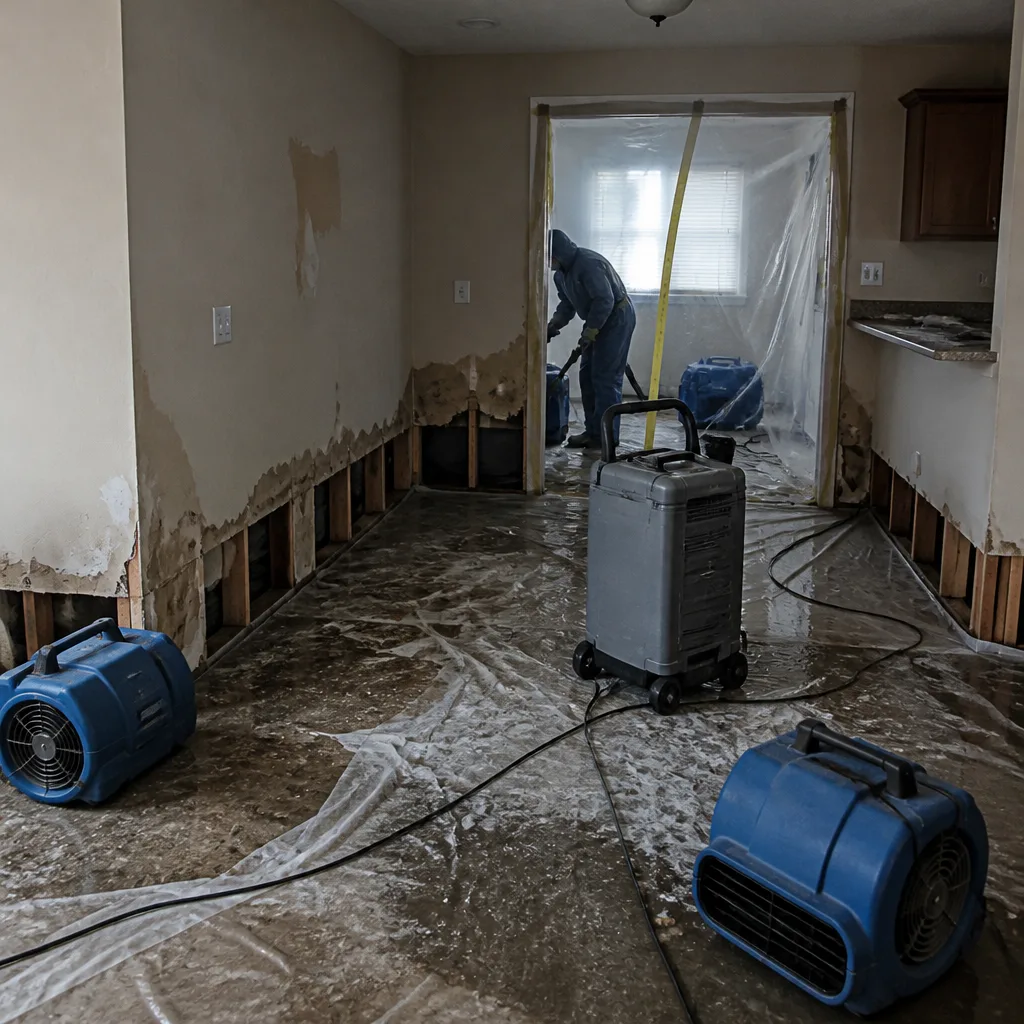 Before
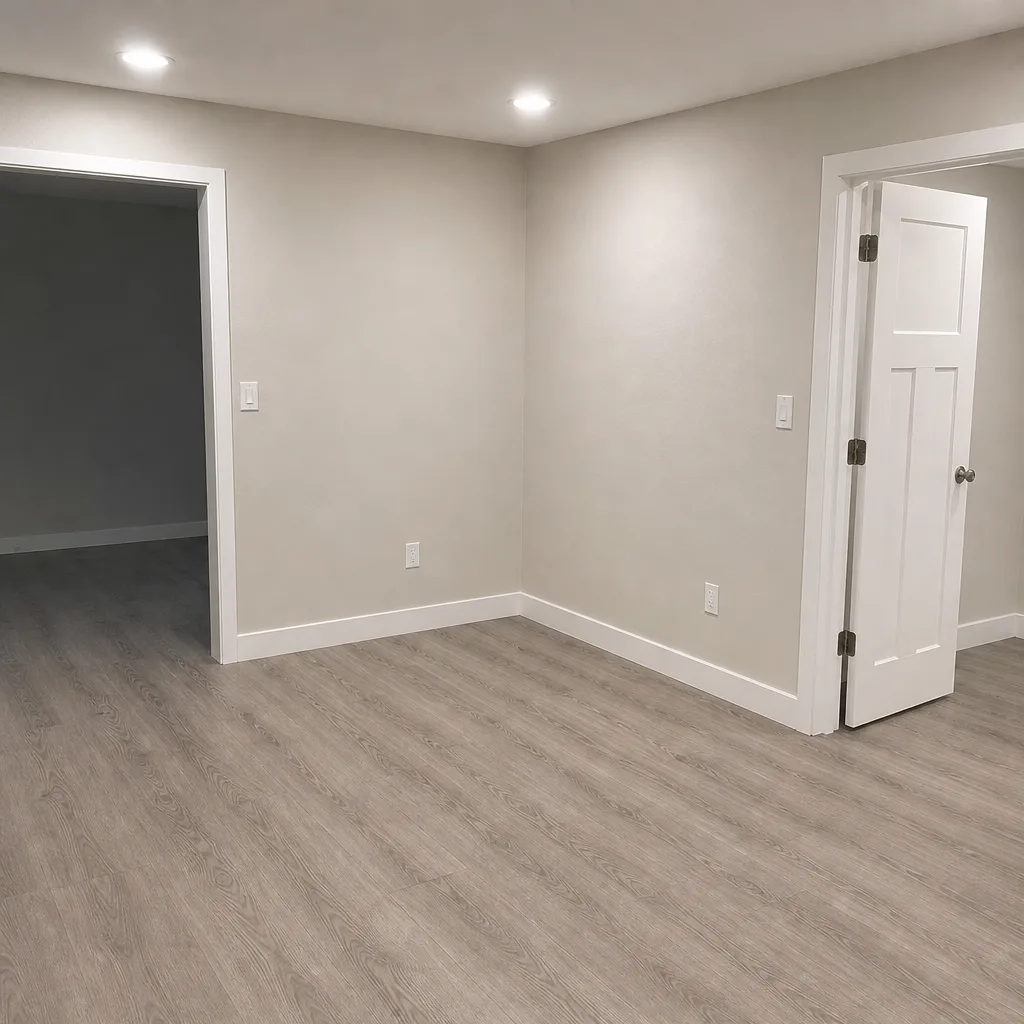 After
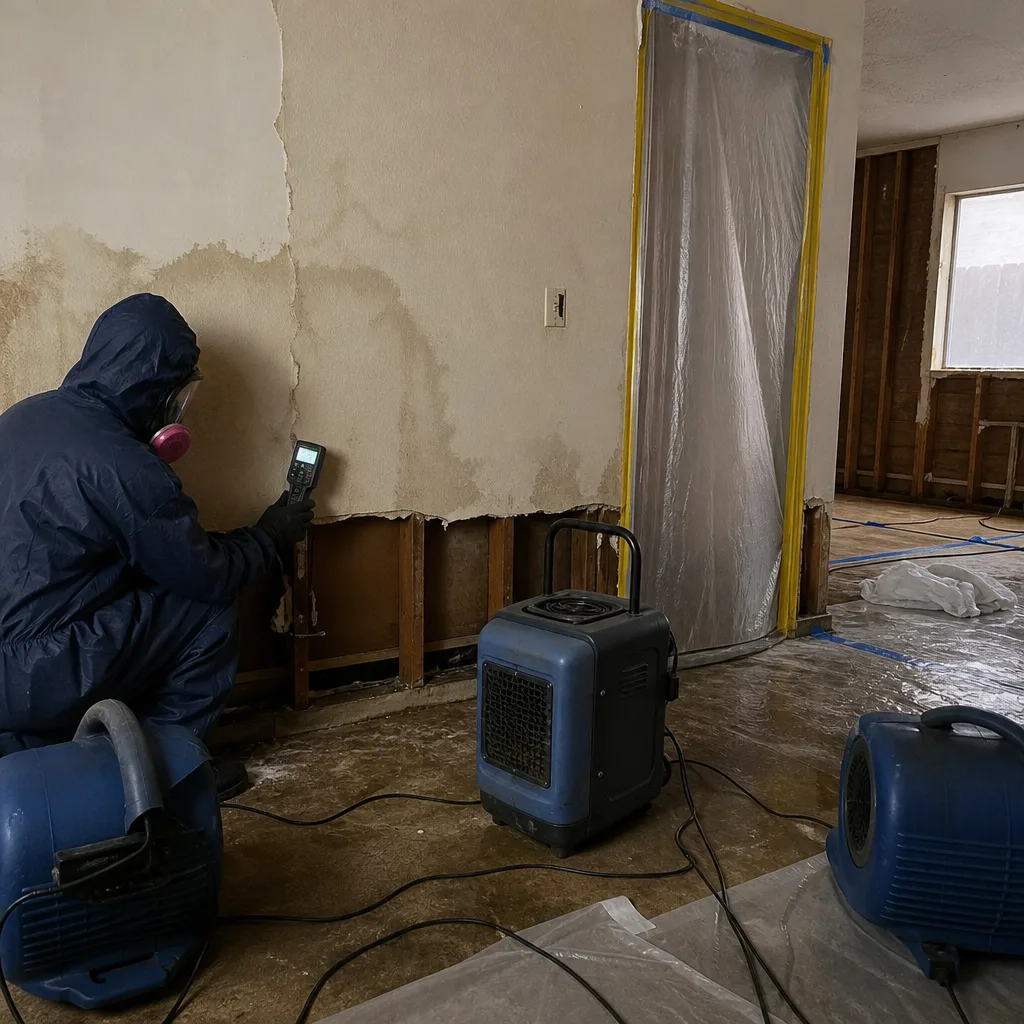 Before
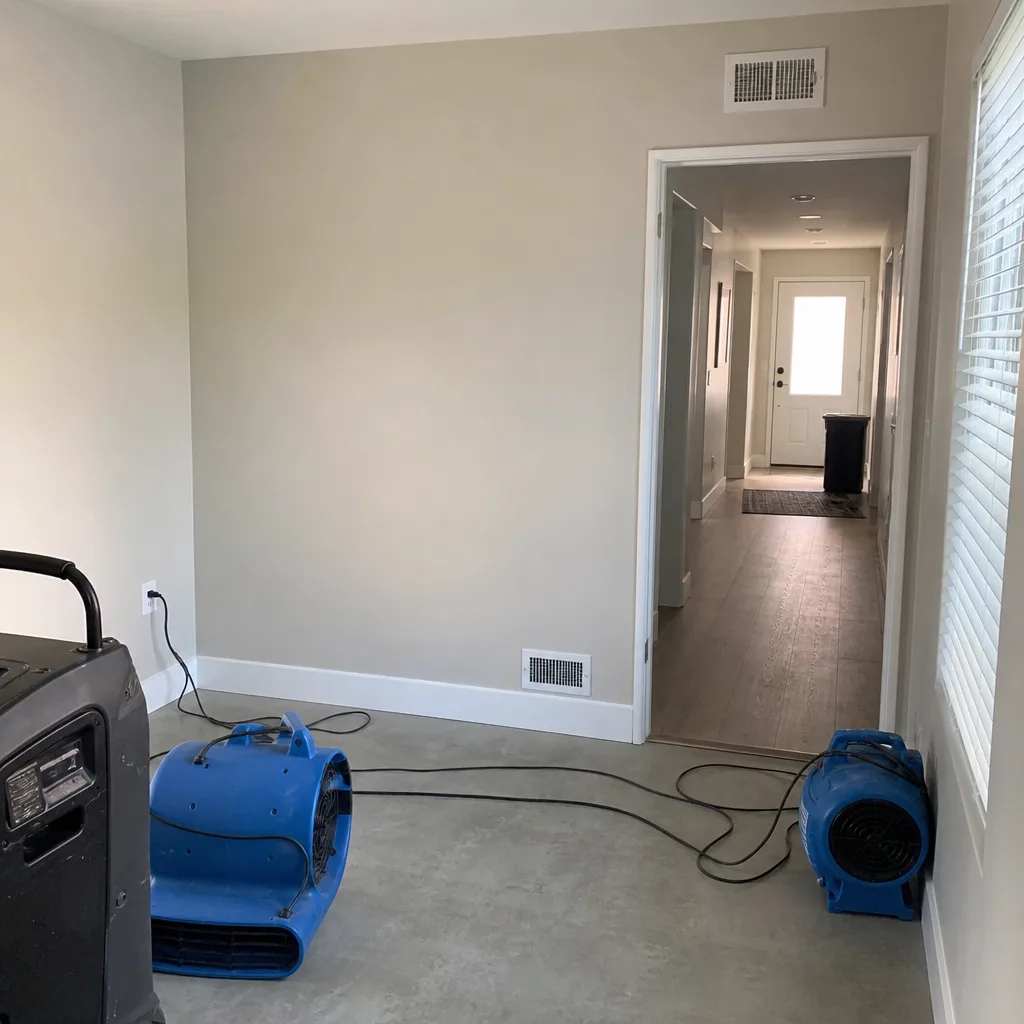 After
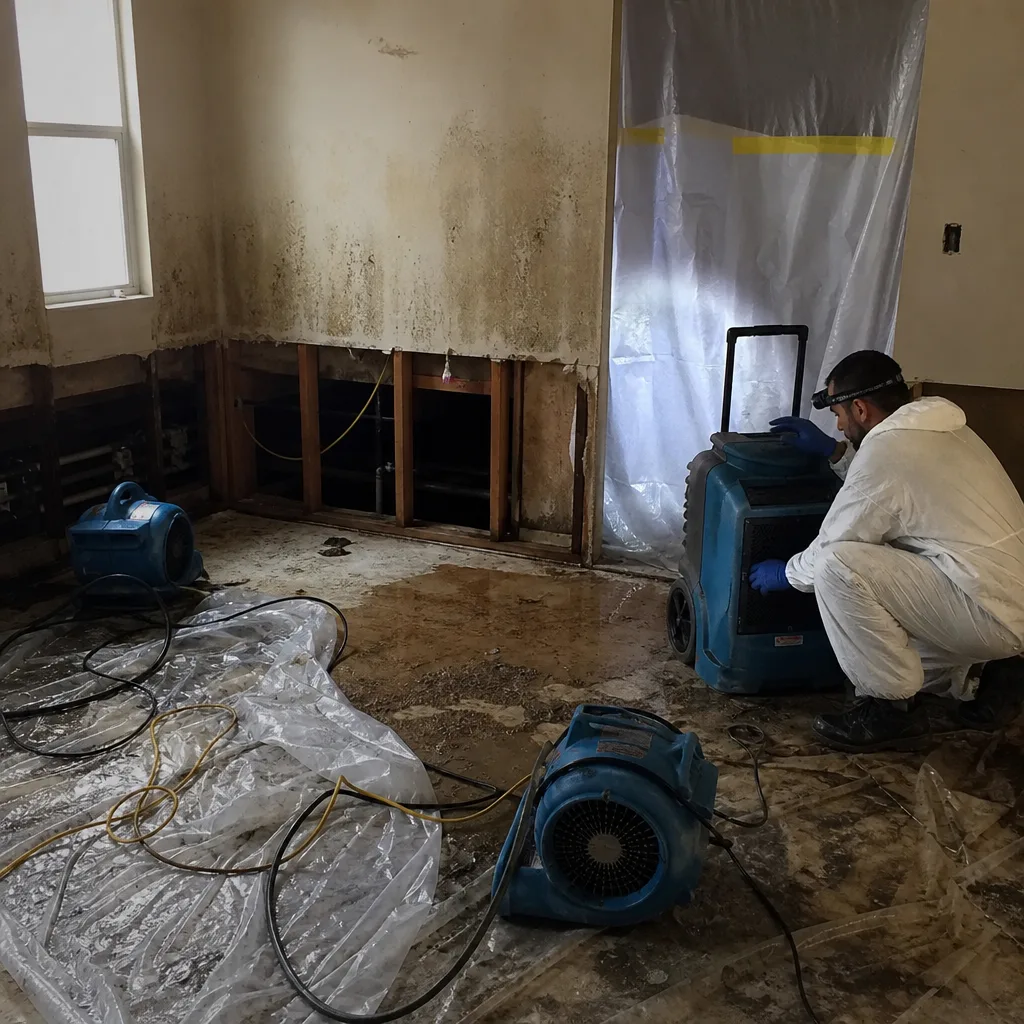 Before
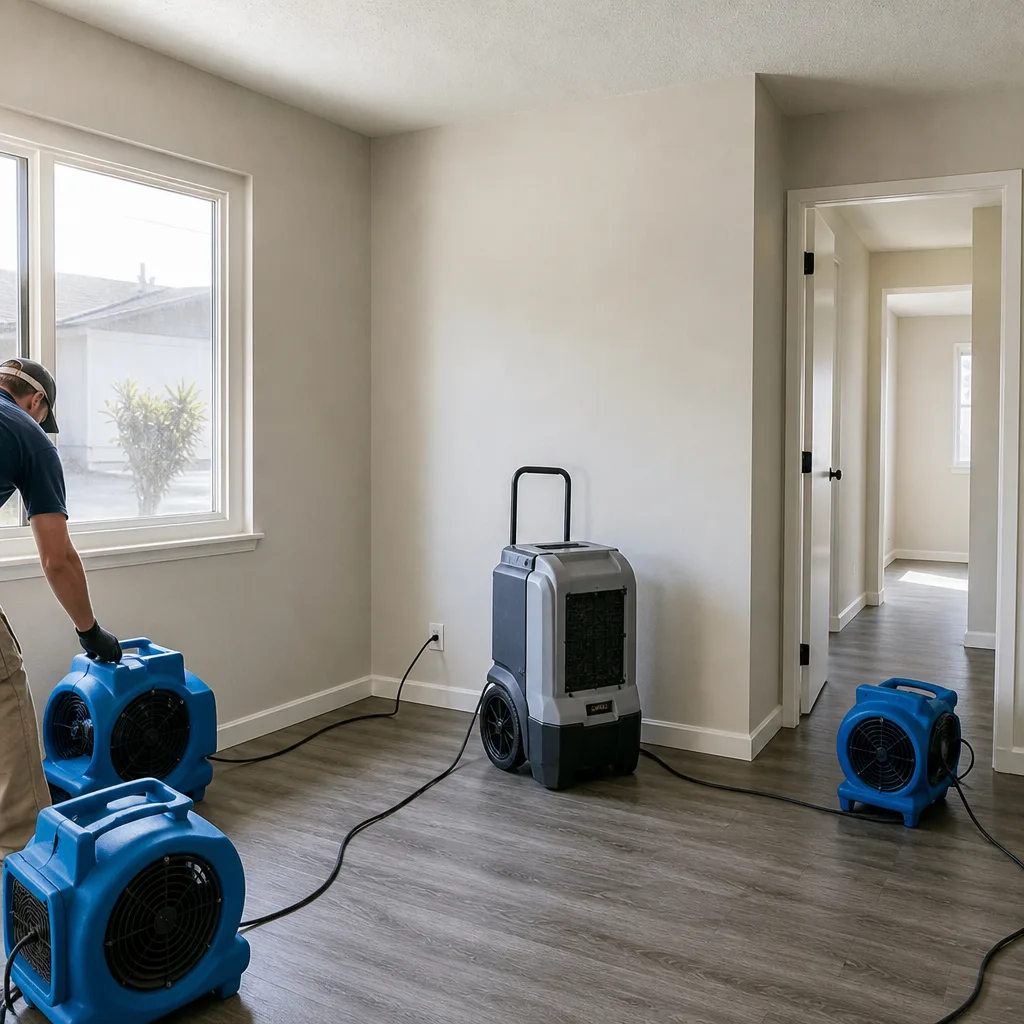 After
When to Call a Professional
Call a professional restoration contractor when the water source has been running for more than an hour, when standing water is deeper than a quarter inch, when water has contacted drywall, baseboards, carpet pad, or wood framing, when the source is a sewage line or outside flooding, when you see visible mold, or when you can’t identify the source. Also call a professional any time a water event involves electrical systems, gas lines, or structural materials you can’t access. In Fontana, most water events that warrant a professional call happen after normal business hours or on weekends, so the number you saved in your emergency binder should be one that answers when it matters. Dry Line Water Damage offers free estimates in Fontana. Call (833) 589-5317 and we’ll talk through what you’re seeing and what to do next while the crew is on the way.
Frequently Asked Questions
Mold colonization on wet organic materials can begin in as little as 24 to 48 hours in Fontana’s summer interior temperatures. The window is shorter in the hot season and only marginally longer in the cooler months, which means the first hour after discovering a water event is the most consequential for prevention. Documenting the damage and starting professional structural drying inside that window is the strongest thing you can do.
Shut off the water source, kill power to affected rooms at the breaker panel, and stop the HVAC system if the water could be contaminated. Then photograph everything before you touch anything, block off the affected area, and call a restoration contractor from your pre-qualified list. The sequence matters because the wrong first move, like running a box fan over sewage water, can expand the contamination rather than contain it.
Consumer-grade equipment cannot pull moisture from wall cavities, under flooring, or from structural framing. A hardware store dehumidifier and box fans will dry the surface while the interior of the structure stays wet, and that hidden moisture is what produces mold and rot. Structural drying requires commercial equipment matched to the water load and verified moisture readings against an IICRC S500 dry standard.
Most standard homeowners policies in Fontana cover sudden and accidental water damage from burst supply lines, water heater failures, and similar internal sources, provided the loss was not caused by neglect or a lack of maintenance. The best way to protect your claim is to document everything in the first hour, call a restoration contractor before the adjuster arrives, and make sure the scope is written before any demolition starts.
Look for a firm with IICRC certification, documented moisture mapping and drying logs, and commercial-grade equipment from brands like Dri-Eaz, Phoenix, and Injectidry. Ask about their process for structural drying and whether they provide written scopes before work starts. Interview them now, save the number, and re-verify once a year so you’re not doing research at 2 a.m. during a flood.
Your binder should include the main water shutoff location, a mapped list of every fixture and appliance valve, the water district emergency number for your service area, Southern California Edison and Southern California Gas Company emergency lines, the City of Fontana non-emergency public works line, your insurance claims number, and your pre-qualified restoration contractor saved at the top. A document you can grab in 30 seconds beats a phone full of bookmarks you can’t find.
The Bottom Line
Emergency preparedness for water damage in Fontana is not a stockpile of supplies. It’s a documented response protocol you can execute in the first hour, because that hour decides whether you’re facing a contained drying project or a mold remediation claim with a much larger scope and a much longer timeline. The preparations are simple: map every shutoff, photograph every incident before touching anything, pre-qualify a restoration contractor with the right certification and the right equipment, and keep a current emergency binder with utility lines for your specific Fontana service area. The time you spend on this before an emergency is measured in hours. The time it saves after an emergency is measured in weeks, and the money it saves is measured in the difference between structural drying and structural reconstruction.
Written by the team at Dry Line Water Damage, serving Fontana since 2013.