Last updated October 31, 2026
 Water damage drying
 Fire & smoke cleanup
 Mold remediation
 Storm response
 Sewage cleanup
 Reconstruction
Free visual inspection and a written scope of work before any mitigation begins - photos, moisture readings, and drying logs go in your claim file
The scope we write is the scope we bill. Anything new gets shown to you, in writing, before we touch it.
Get your free estimateThe Complete Water Damage Restoration Guide for Fontana Homeowners
Most water damage callbacks we see in Fontana, the mold discoveries behind baseboards, the buckling laminate, the insurance disputes that stall for months, trace back not to the water itself, but to a drying phase that was declared finished before moisture readings actually confirmed it. The water came out. The air felt dry. The equipment came down. And somewhere inside a wall cavity between Cherry Avenue and Sierra Lakes, moisture kept working on the framing. This guide maps the full restoration sequence with the technical checkpoints a qualified Water Damage Restoration services crew uses, so you can verify the work being done on your property rather than taking a verbal “it’s dry” on faith.
Quick Answer
Water damage restoration in Fontana is a sequenced, equipment-driven process: extract standing water, map moisture in all affected materials, install commercial-grade drying systems, document daily moisture decline, and confirm clearance with calibrated meters before any equipment is removed. Done properly, it typically runs 3 to 5 days for structural drying, longer if materials require removal or repairs follow. A legitimate restoration follows the IICRC S500 standard and produces a written drying log at every phase.
Restoration work we handle
Table of Contents
- What Actually Happens During Restoration
- Why Fontana’s Climate Hides Moisture
- Water Categories: Cat 1, Cat 2, Cat 3
- The Drying Sequence, Phase by Phase
- What a Proper Drying Log Looks Like
- Why Equipment Brands Matter
- Documentation That Protects Your Insurance Claim
- Common Mistakes to Avoid
- When to Call a Professional
- Frequently Asked Questions
What Actually Happens During Restoration
A water loss in Fontana follows the same physical laws whether it’s a slab leak on a 1970s rambler near the 10 freeway or a supply-line burst in a newer development up by Etiwanda Creek. Water migrates. It moves through drywall, wicks up through subfloor, travels along framing members, and settles into the lowest cavities. The goal of restoration is not to make the surface look dry. It is to return every affected material to a documented moisture content that matches its dry standard, the baseline measurement an unaffected portion of the same material would show.
The water damage restoration process in Fontana follows the IICRC S500 standard, the industry’s reference document for professional water restoration. S500 defines four categories of water (we’ll cover those shortly) and establishes procedures for everything from initial inspection to final clearance. A contractor who says they follow S500 is committing to a specific protocol: identify the water source, determine the category and class of loss, establish drying goals, install appropriate equipment, monitor daily, and document until the structure meets its dry standard.
What budget operators skip is the monitoring. Extraction is straightforward. Anyone can place a few air movers. The failures happen when nobody returns with moisture probes to verify what’s happening inside wall cavities and floor systems. A crew set up blowers on day one and walked away is not performing restoration. They’re performing air circulation.
Why Fontana’s Climate Hides Moisture
The Inland Empire’s low humidity is both a blessing and a trap. During summer water losses, surface materials in Fontana can feel dry to the touch within hours. Sheetrock may show no visible staining. A homeowner runs a hand across the floor and concludes the worst is over. But the humidity inside a wall cavity or beneath a tile floor is not the same as the air in the hallway. The water went somewhere, and gravity carried it down and outward into enclosed spaces that receive no air movement from an open window or a ceiling fan.
We see this repeatedly in Fontana’s housing stock. The city’s mix of post-war slab-built homes and larger two-story builds from the 1990s and 2000s creates specific drying challenges. Slab construction means water beneath flooring can’t drain downward; it sits against the concrete and migrates laterally. Two-story losses in the eastern developments near Lytle Creek move water through floor joists and ceiling cavities, where the damage remains invisible until the ceiling below starts to stain or sag.
The professional response to this false sense of fast drying is moisture mapping. Proper restoration uses penetrating and non-penetrating meters to establish a map of affected areas, including the cavities you cannot see. Readings are taken on day one, logged daily, and compared to dry standards for each material. Only when the numbers confirm dryness, not the feel of the air, does equipment come down.
Water Categories: Cat 1, Cat 2, Cat 3
The IICRC S500 standard classifies water by its contamination level at the time of the loss. The category determines what gets dried, what gets removed, and what level of antimicrobial treatment is appropriate. This is not a formality. The category fundamentally changes the scope and cost of a Fontana restoration.
Category 1: Clean Water
Clean water originates from a sanitary source: a supply line, a faucet left running, a ruptured pipe, rain before it contacts contaminants. Category 1 water can degrade if it sits, but if extracted and dried promptly, affected porous materials like drywall and carpet pad can often be saved. A slab leak in Fontana typically starts as Category 1, though time begins shifting it toward Category 2 as the water picks up soil contact and bacteria.
Category 2: Gray Water
Gray water contains significant contamination: dishwasher or washing machine discharge, sump pump failures, toilet overflow with urine but no feces. This water can cause illness through skin contact or ingestion. Porous materials in Category 2 losses generally require removal or thorough disinfection. Carpet and pad usually go. Drywall that absorbed gray water is cut out rather than dried in place.
Category 3: Black Water
Black water is grossly contaminated: sewage backups, floodwater from outside, water containing feces, or standing water that has incubated bacteria for extended periods. Category 3 always requires removal of affected porous materials. No responsible contractor dries sewage-soaked carpet or drywall. The work expands to include controlled demolition, containment, and sanitization of remaining structural surfaces. Fontana homeowners with sewer backups or toilet overflows need to understand this: what looks like a dry-out is actually a removal and reset.
The Drying Sequence, Phase by Phase
Restoration is not improvisation. It is a sequence, and each phase has a specific output. If a phase is skipped or under-performed, the following phase cannot succeed. Here is the full sequence as practiced by IICRC-certified crews.
- Emergency contact and dispatch. The first call establishes what happened, whether the source is stopped, and whether the water is still flowing. For active leaks, the immediate priority is water shutoff. For sewage, residents should vacate affected areas until containment is established.
- Inspection and source identification. A technician inspects the property to identify the water source, determine the category and class of loss, and map affected areas. This inspection uses moisture meters, thermal imaging where available, and visual assessment. You should receive a written scope of work at this point.
- Extraction. Standing water is removed using truck-mounted or portable extraction units. Extraction is the single highest-leverage phase in the entire restoration. Every gallon physically removed before drying begins reduces drying time exponentially. A common failure is rushing through extraction and relying on dehumidifiers to do extraction’s job.
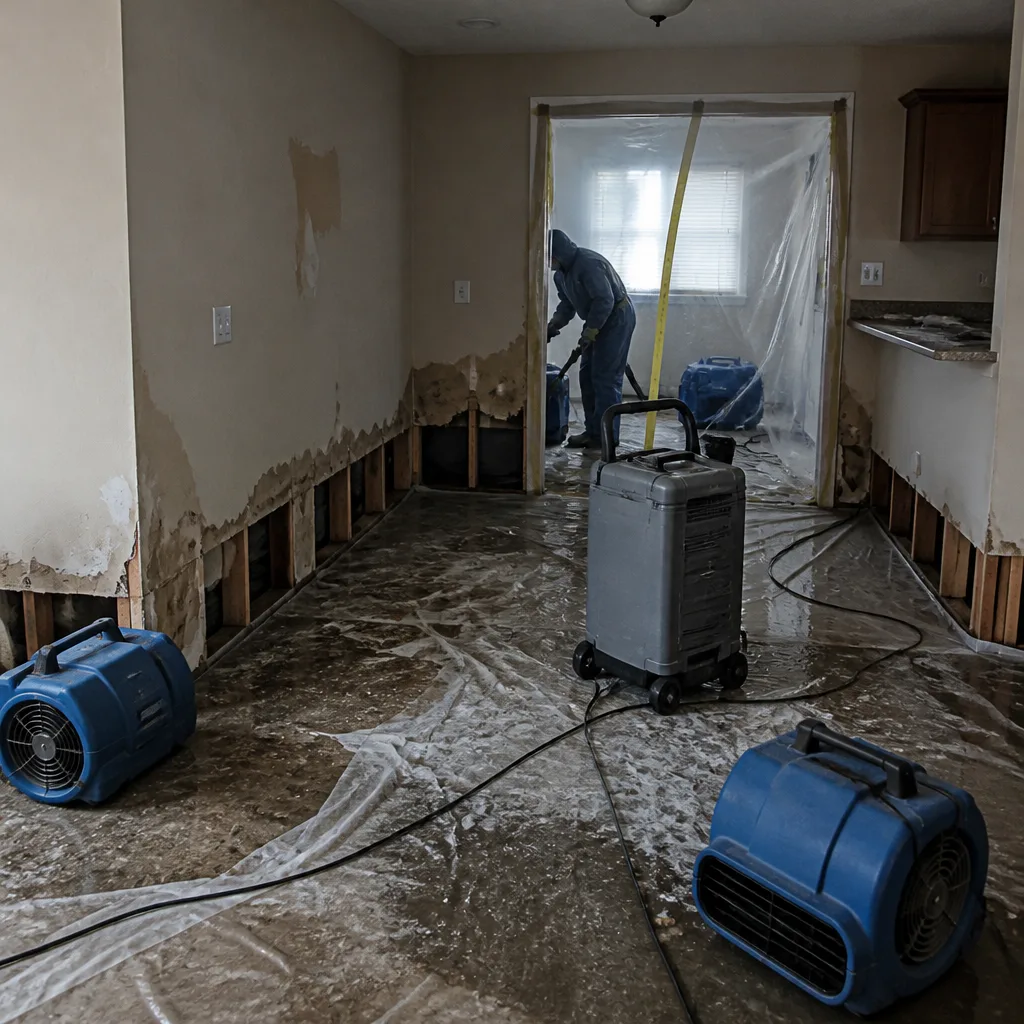
- Controlled demolition. Materials that cannot be economically dried, baseboards, saturated drywall in Category 2 or 3 losses, carpet pad, damaged trim, are removed. In Category 3 losses, containment barriers are established before demolition begins to prevent cross-contamination.
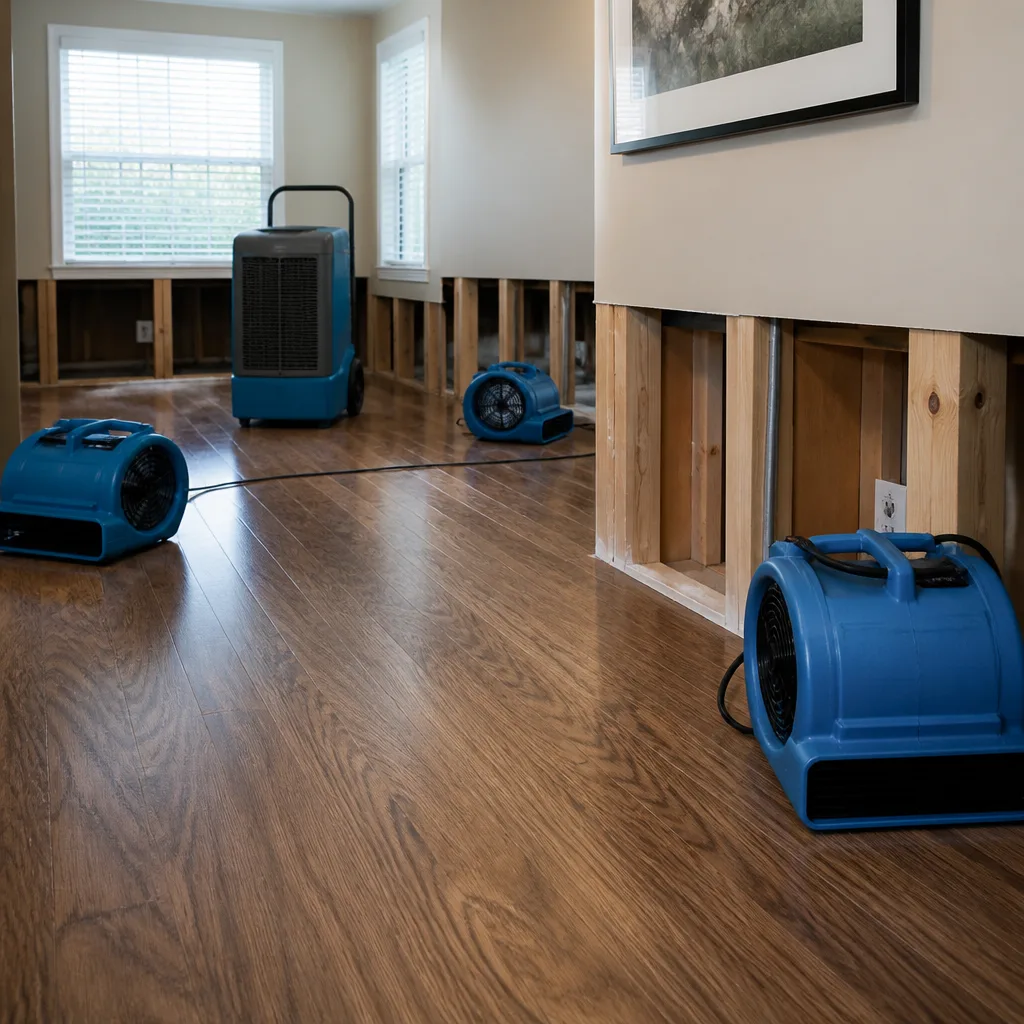
- Structural drying setup. Commercial-grade air movers and dehumidifiers are positioned to create airflow across wet surfaces and reduce ambient humidity. For enclosed spaces, Injectidry systems deliver air into wall cavities, under cabinets, and beneath flooring. The equipment layout is specific, not random: air movers create a vortex pattern around the room perimeter; dehumidifiers are sized to the water class and cubic footage.
- Daily monitoring. Each day, moisture readings are taken and logged. Temperatures and humidity levels are recorded. Equipment is adjusted as drying progress dictates. This is the phase that separates professional restoration from equipment rental. If no one returns with a meter, you do not have a restoration in progress.
- Clearance readings and equipment removal. When all affected materials measure at or below their dry standard, the structure has achieved what we call documented dry. Equipment is removed at this point, not before. You should receive a final drying log.
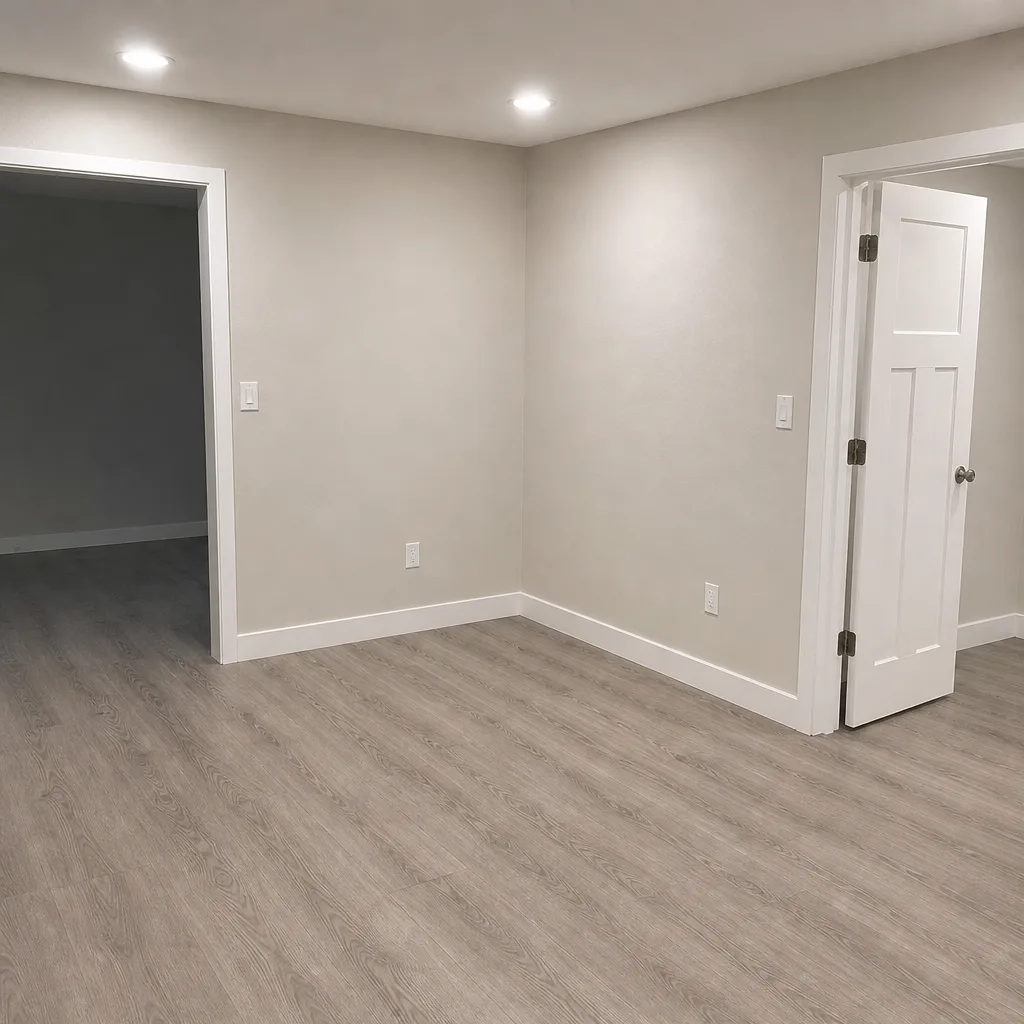
- Repair and reconstruction. The final phase returns the property to pre-loss condition: new drywall, paint, flooring, baseboard, trim. If restoration and reconstruction are handled by the same crew, the transition from drying to building is seamless because the drying verification is already done.
In our experience, a question we hear often from Fontana homeowners is whether this sequence can be compressed. The answer is no, not without risk. Drying is physics, and physics doesn’t negotiate. What can be compressed is the response time before the sequence begins, which is why activation speed matters more than drying speed.
What a Proper Drying Log Looks Like
A drying log is the single most important document in a water loss, and it is the one most often missing when a homeowner has problems later. The log is a daily record of moisture readings, ambient conditions, and equipment status. It proves the structure was dried to a measurable standard, not left to air-dry until someone’s guess said it was fine.
A proper drying log includes:
- Initial moisture map with readings from each affected room and material type.
- Dry standard for each material type, established from an unaffected reference sample of the same material.
- Daily readings from each marked point, taken with a calibrated meter, showing progressive moisture decline.
- Daily ambient temperature and relative humidity readings.
- Equipment inventory: how many air movers, which type, how many dehumidifiers, what AHAM pint ratings, where positioned.
- Adjustments made: equipment added, relocated, or removed based on drying data.
- Date, time, and technician name for every entry.
- Final clearance readings showing each affected material at or below its dry standard.
You should have this log in hand before the last piece of equipment leaves your Fontana property. If the restoration company cannot or will not produce it, you do not have documented dry. You have an invoice and a hope.
Why Equipment Brands Matter
All air movers push air. All dehumidifiers remove moisture. That does not make them equal. The difference between consumer-grade rental machines and the equipment used on commercial losses is capacity, airflow, efficiency, and durability. A restoration that takes seven days with homeowner-grade equipment may take four days with the right tools, which is less time for mold to establish and less time your family lives in a construction zone.
Professional restoration companies in the Inland Empire run Dri-Eaz and Phoenix equipment for a reason. Dri-Eaz dehumidifiers are engineered for the continuous-duty demands of large-loss restoration, with capacities far beyond big-box rental units. Phoenix’s low-grain refrigerant technology pulls water from the air at humidity levels where lesser machines stall. The brands have earned their place on serious restoration trucks because the industry’s largest contractors stake their reputations on them.
For enclosed structural cavities, Injectidry technology changes what can be dried without demolition. The system pushes low-pressure airflow into wall cavities, under cabinets, beneath vinyl flooring, and through floor joist spaces. The result: water that would otherwise require cutting into walls to dry gets removed through engineered airflow. For a Fontana homeowner, this means less demo, less repair, shorter restore time, and a smaller reconstruction bill. It is not magic. It is plumbing air exactly where the moisture is.
Documentation That Protects Your Insurance Claim
In nearly every water loss, an insurance adjuster is in the room, whether they’ve visited yet or not. Your claim’s outcome depends heavily on the documentation the restoration crew produces. The adjuster is not on site daily. They rely on the drying log, photos, scope documentation, and moisture readings to validate the claim. Poor documentation leads to disputes, delays, and underpayment.
A restoration company that works daily in the Inland Empire insurance environment understands what adjusters look for. They document the cause, not just the result. They photograph every affected area before, during, and after. They map moisture values. They keep a daily log that shows drying progress measured against a defensible standard. They can provide the full paperwork package to your adjuster directly, in the format the insurer’s software expects.
If you’re facing a water loss in Fontana and the restoration contractor cannot provide this level of documentation, you’re likely covering the gap yourself, as we explain in our Damage Restoration Emergency Preparedness Guide for Fontana Homes. It is not your job to learn the S500 standard. It is the contractor’s job to apply it and prove they did.
Common Mistakes to Avoid
- Waiting to call. The first 48 hours after a water loss are critical. Mold can establish in as little as 48 to 72 hours in Fontana’s warm season. Every hour of delay increases the scope of materials that require replacement.
- Using consumer rental equipment. A big-box carpet cleaner will not dry wall cavities. A homeowner-grade dehumidifier will not pull grain depression sufficient for structural drying. You will spend money and still need a professional in the end.
- Assuming surface dryness means dry. We have already covered this, and it bears repeating: what you can feel is not what is happening. Only calibrated moisture meters measure actual material moisture.
- Not documenting the initial damage. Photos, video, a written timeline. If you plan to file an insurance claim, document everything before cleanup begins. Your adjuster needs what the restoration crew cannot capture because it’s already gone.
- Hiring a contractor who won’t provide a written scope. A verbal estimate is not a scope. You should have, in writing, what will be done, what standards will be used, what materials will be removed, and what the drying process includes before any work starts.
- Overlooking hidden water sources. In Fontana’s slab-built homes, a supply leak under the foundation can saturate wall plates and wick upward through framing without ever producing visible standing water. Musty odors or unexplained buckling are red flags, not mysteries to ignore.
- Conflating restoration with construction. A remodeling contractor dries surfaces. A restoration contractor dries structures. The difference is measurable moisture content in hidden cavities versus how things look. If you have water inside your structure, you need the first kind of expertise.
When to Call a Professional
Any water that has touched drywall, flooring, cabinetry, or structural framing warrants a professional assessment. Check visible standing water more than what towels can handle. The same applies if water came from sewage or exterior flooding. If you can smell moisture but can’t see it, call. If the water has been present more than a few hours, call. If you have a slab leak, a supply line break, a toilet overflow that reached flooring, you need a professional in Fontana. Dry Line Water Damage offers free estimates, call (833) 589-5317.
Frequently Asked Questions
Most structural drying in Fontana completes within 3 to 5 days when professional equipment is properly deployed. Reconstruction following drying adds time depending on scope, often 1 to 3 weeks for moderate losses. Slab leaks under flooring can extend drying time because water migrates beneath materials with no air access until the flooring is addressed. Call (833) 589-5317 for an honest timeline for your specific loss.
Most homeowner policies cover sudden and accidental water damage, such as a ruptured supply line or an appliance failure, but not gradual damage from long-term leaks or lack of maintenance. Coverage also depends on the water source and whether the loss was caused by a covered peril. A restoration contractor with strong documentation practices can help substantiate your claim. Call (833) 589-5317 to discuss your situation before assuming your claim will be denied.
You can remove surface water, and you should, but you cannot dry structural cavities without penetrating airflow and real dehumidification. Consumer fans blow air across surfaces, not inside walls. Rental dehumidifiers lack the capacity for structural drying. The hidden moisture is where mold and rot establish. Professional restoration is not an upsell; it is a different class of work.
If water touched only non-porous surfaces like tile or concrete, cleaning and drying may suffice. If water touched drywall, baseboards, cabinetry, or flooring, water is almost certainly behind and beneath those surfaces, where a mop cannot reach. The answer depends on moisture readings, not on how the area looks. That’s why an inspection with calibrated meters is the only way to know. Call (833) 589-5317 for a free assessment.
The Institute of Inspection, Cleaning and Restoration Certification maintains the S500 standard for professional water restoration, the industry’s required methodology for proper drying. An IICRC-certified firm commits to a specific process: inspection, extraction, drying to documented moisture standards, and final clearance. It is a third-party certification, not a self-issued badge, and checking for it is a legitimate part of vetting any restoration contractor in Fontana.
A slab leak in Fontana’s post-war housing often saturates wall plates, wicks through drywall from the bottom up, and travels beneath flooring across rooms. Moisture readings may be needed throughout the area, not just where you saw the first sign. Long after the leak is stopped, the water that already migrated can remain. This is exactly the condition that structural drying and moisture mapping is designed to resolve.
The Bottom Line
Water damage restoration in Fontana is a technical process with a defined standard, documented phases, and measurable outcomes. The work is not finished when the floor looks dry. It is finished when moisture meters say the material has returned to its dry standard. Choosing a contractor who follows IICRC protocols, runs commercial-grade equipment, and documents every day of drying protects both your property and your insurance claim, and you can find more guides & resources on our blog to help you through the process. If you’re facing a water loss, the right call is a free assessment from a restoration company that treats documented dry as the only acceptable outcome. Call Dry Line Water Damage at (833) 589-5317.
Written by the team at Dry Line Water Damage, serving Fontana since 2013.
See the difference
 Before
 After
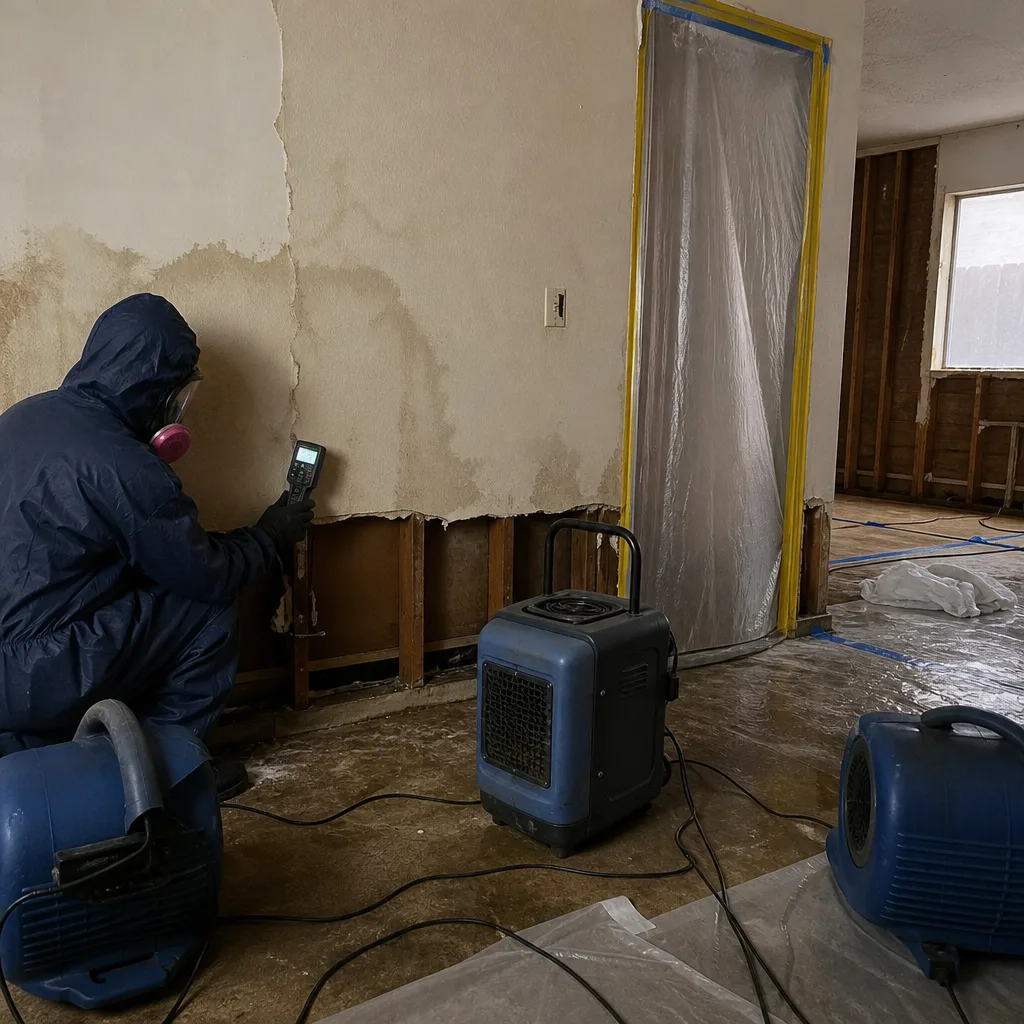 Before
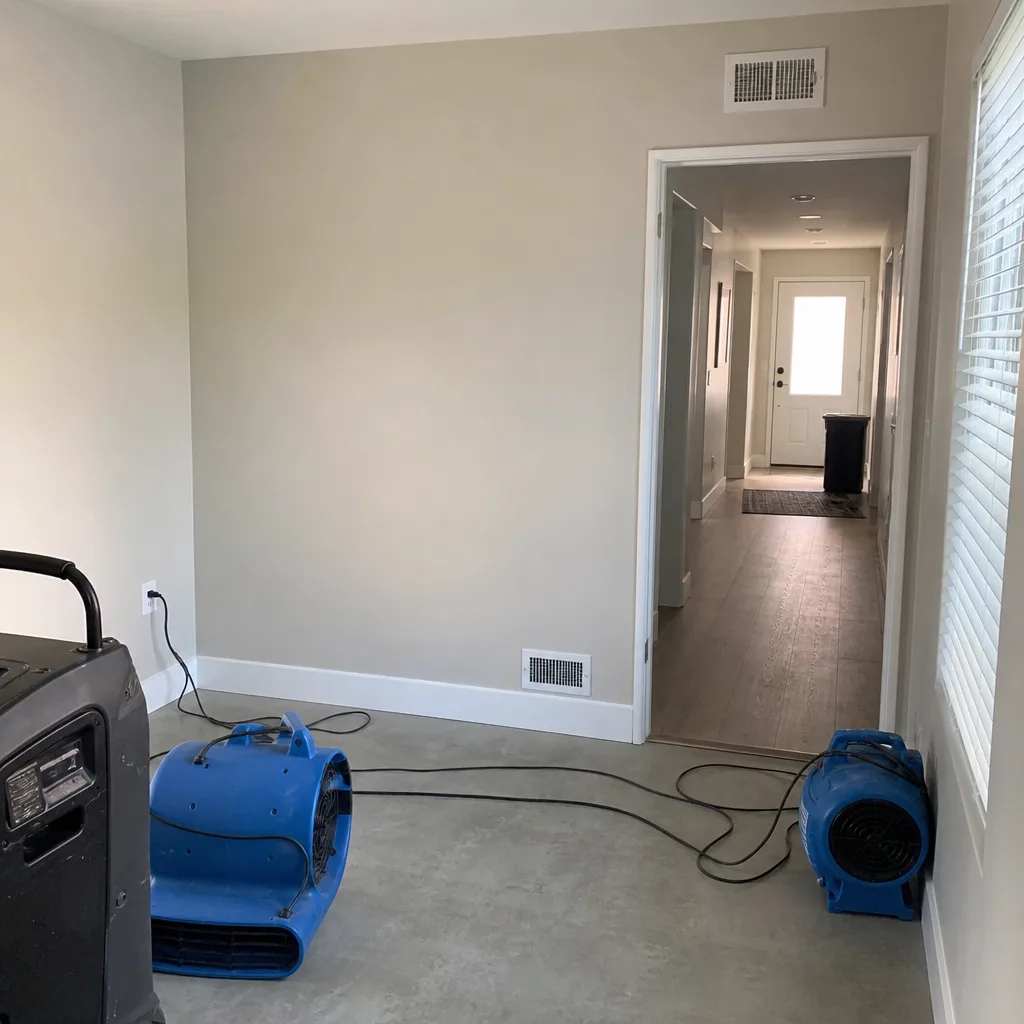 After
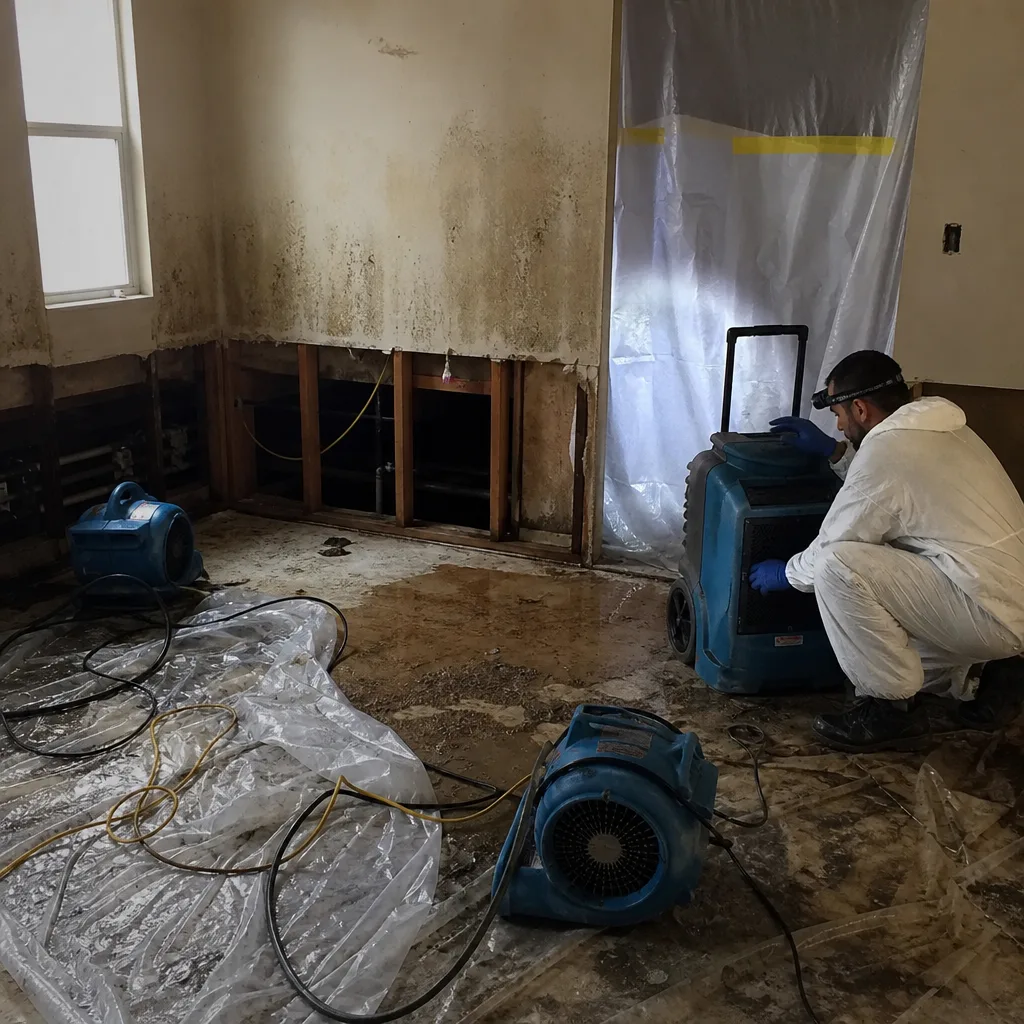 Before
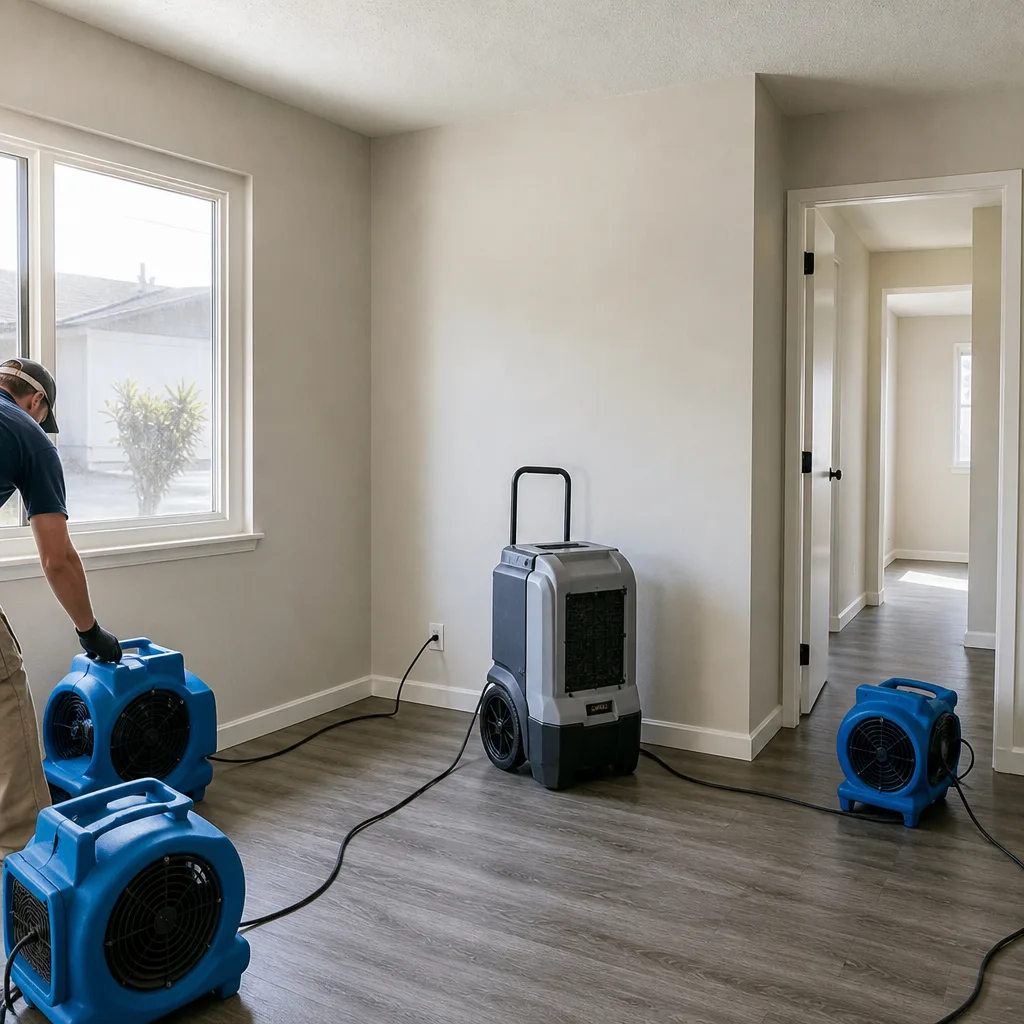 After